
Years ago girls looked forward to getting their first pairs of high-heeled shoes when they turned 16 or 18. It was a "rite of passage" to womanhood, a much-anticipated event. As the years have passed, our girls have been pulled from girlhood to womanhood much more rapidly than before. We now have 8-year-olds dressing like teenie-boppers and 6-year-olds dressing like Brittney Spears. A girl's first pair of high-heeled shoes isn't as big a deal now. 14-year-olds started wearing high-heels, then 12-year-olds, now 8-year-olds. (This post has nothing to do with whether or not this is a problem.) The point is that all women (and girls) want high-heeled shoes, it seems.
Except me.
You see, I've always been tall for my age - which has its definite advantages, I might add! I'm not complaining about my height; in fact, I quite like it. I was thrilled when I passed my mom up in height - somersaults, fireworks, block party :).
The point being, I'm already tall enough. I stopped growing when I was about 15 after topping 5'9". I don't need extra height. I already feel like I dwarf other people; I'm taller than my mother, my sister, my grandmothers, my aunts, my cousins, and all my (female) friends. So when I buy shoes for my extra-large feet, I avoid heels like the plague.
Let's face it. Five feet and nine+ inches of towering klutz is just not a good mix with heels. I'm not as klutzy as I once was, but I'm no graceful ballerina, either. With heels, I would just get taller and clumsier. So I've resisted heels at all costs. I might add that it is exceptionally hard to find size 10 1/2 wide shoes that do not have heels. I hate shopping for shoes, but I digress. . .
Now for the confession: I just bought my first pair of high-heels.
I know, I know, I finally caved in and succumbed to peer pressure. Sort of. Well, not really.
Actually they're for my friend's wedding. Being a bridesmaid comes with certain responsibilities; one of them is evidently to wear high-heels. I write this good-naturedly :). Lydia is so wonderful not to require really tall high-heels; these ones are only about 1.5 or 2 inches and they are wider heels as opposed to "toothpick heels." All in all, not that bad; I just love to dramatize. . .
So today, for the sake of a long-time friendship, I participated in one "rite of passage" to womanhood that I have long been resisting. I bought high-heels. *sigh* It had to happen one day, I suppose.
I have already made a disclaimer to Lydia that if her maid-of-honor trips and falls flat on her face walking down the aisle, she has been forewarned :). Pray for me on March 18. All my attention is going to be on making it down that aisle and back without stumbling. And Lydia thinks she'll be nervous that day. Ha!
Meanwhile, I'm going to be doing a lot of practice around the house :). I've already been tottering around and I feel like Treebeard: tall and bumbling. I just need a few hobbits to sit on my shoulders. Volunteers, anyone?
Wednesday, February 15, 2006


Tuesday, February 14, 2006
It Doesn't Take an Economic Genius. . .
I'm no economics expert. I did well in economics in high school and college, but hated both classes. It was boring; it was rote; it was so disconnected with reality. I usually can remember things because I find facts interesting; I didn't find economics interesting, so I didn't retain much of it. My high school economics was okay, but the book was dry. My college economics course. . . *shudder*
It was an evening class, which didn't help matters. The teacher had a thick accent that was hard to understand, and she had handwriting that resembled hieroglyphics; these two factors made the class hard to follow. The teacher told us that she would be 10 minutes late to class every day because she refused to leave her house more than an hour before start time, and she told us to just wait for her. Half way through our class we also had a smoking break since the teacher was an addicted chain smoker. It was kind of amusing, but sad. Take a 75 minute class, subtract 10 minutes off for starting late, then 5 minutes for a smoking break, and we have a 75 minute class that really only meets for 60 minutes. You would think an economics teacher would realize the problems with this, especially as relates to her pay scale.
Most notable, though, the class was just disconnected from real people and real life.
By the end of the semester I twitched if someone mentioned IBM, peanut butter, coke, or Kroger. Every "real-life" example given in lecture related to one or more of those four things. Did you know that the price of peanut butter at Kroger can rise from $2 to $8 in the course of a few days. Did you know that evidently everyone works an IBM computer job? We were actually told by the teacher that there shouldn't be any complaints about homework because we can just do it at work since we don't have anything else to do there anyway. So much for the waitresses, the cashiers, and those of us who don't have jobs. Oh, and since women entering the workforce stimulates our economy and raises our GNP, that is sufficient reasoning that all women should work. Glad we got that straight.
So, needless to say, I didn't relish my economics education a great deal, and what doesn't interest does not stick for long. All that to say, I'm not well-versed in economics, though I wish I was.
However, I am sharp enough to realize how utterly ridiculous this nonsense is. I realize the United States has long ceased to be a free market, but this is just plain stupid. Regardless of the moral implications of selling "emergency contraceptives," it just makes absolutely no sense to require a pharmacy to sell them. If you're unhappy with the offerings, go somewhere else. That's what competition is. It doesn't take an economic genius to figure that out.
It was an evening class, which didn't help matters. The teacher had a thick accent that was hard to understand, and she had handwriting that resembled hieroglyphics; these two factors made the class hard to follow. The teacher told us that she would be 10 minutes late to class every day because she refused to leave her house more than an hour before start time, and she told us to just wait for her. Half way through our class we also had a smoking break since the teacher was an addicted chain smoker. It was kind of amusing, but sad. Take a 75 minute class, subtract 10 minutes off for starting late, then 5 minutes for a smoking break, and we have a 75 minute class that really only meets for 60 minutes. You would think an economics teacher would realize the problems with this, especially as relates to her pay scale.
Most notable, though, the class was just disconnected from real people and real life.
By the end of the semester I twitched if someone mentioned IBM, peanut butter, coke, or Kroger. Every "real-life" example given in lecture related to one or more of those four things. Did you know that the price of peanut butter at Kroger can rise from $2 to $8 in the course of a few days. Did you know that evidently everyone works an IBM computer job? We were actually told by the teacher that there shouldn't be any complaints about homework because we can just do it at work since we don't have anything else to do there anyway. So much for the waitresses, the cashiers, and those of us who don't have jobs. Oh, and since women entering the workforce stimulates our economy and raises our GNP, that is sufficient reasoning that all women should work. Glad we got that straight.
So, needless to say, I didn't relish my economics education a great deal, and what doesn't interest does not stick for long. All that to say, I'm not well-versed in economics, though I wish I was.
However, I am sharp enough to realize how utterly ridiculous this nonsense is. I realize the United States has long ceased to be a free market, but this is just plain stupid. Regardless of the moral implications of selling "emergency contraceptives," it just makes absolutely no sense to require a pharmacy to sell them. If you're unhappy with the offerings, go somewhere else. That's what competition is. It doesn't take an economic genius to figure that out.
A Valentine's Day Prayer from a Maiden-in-Waiting
Lord, today I count abundance, not drought. I may not have the romantic love of a man, but I have your unconditional love; I have the love of the Creator of the Universe! I have the love of my Savior. You didn't just tell me that you loved me, Lord; you showed me you did by dying for me.
John 15:13 Greater love has no one than this, that someone lays down his life for his friends.
I thank you, Lord, for the great love of two godly parents, the love of a brother and sister, and the love of countless extended family and many friends.
I am blessed, Lord. My life is not absent of love; rather, it is overflowing with the love of many, many people. I do not deserve such love, but I thank you for it.
I pray that someday I will have an earthly bridegroom, but for now I am learning to cherish my Heavenly Bridegroom. Lord, draw me still closer to you.
Amen.
Sunday, February 12, 2006
Under Grace, Part III
Read my first two posts on grace here and here.
I usually have many posts drafted in my blogger account and still more in the files of my brain. I have a lot of things which I would like to eventually write. I start a post, jot down a few thoughts, and then leave it to simmer until my thoughts are more clear or my time is more free. Right now I have drafted a post on caring for long hair, a post on one of my favorite L.M. Montgomery books, and a post on the negative effects of anti-male comments, just as a sampling. One post I have had drafted for several weeks is titled "Why I Want to Homeschool My Children Someday," but now that's not the post that I feel the need to write.
I have been so blessed though the pastor who has recently come to our church. Not blessed in a comfortable sense, since his sermons have made me far from comfortable; on the contrary, I am blessed in an uncomfortable sense. I have never had a string of sermons be so convicting as the last three he has given. I have a different perspective on the Christian life than I did a few weeks ago, as I have mentioned to an extent in previous posts. My sister and I were discussing yesterday the far-reaching applications of Mark 7:1-13, applications that continue to stretch farther and farther as I meditate on that passage.
Some of you may remember my posts on grace here and here, which I wrote a few weeks ago. My views on many seemingly unrelated issues have been affected just by the one sermon mentioned in the second post and still further affected by the two subsequent sermons, which tied together nicely with the first. I keep thinking that I've uncovered all the connections that relate to my life, but then I find another stone that has been left unturned. I have been (and continue to be) both an antinomian and a legalist.
The first post I wrote was a needed critique of the heresy of antinomianism. As Christians we are not slaves of sin, but we are slaves of righteousness. Martin Luther put it this way: "We are not saved by works; but if there be no works, there must be something amiss with faith." What I didn't know as I wrote my post on antinomianism was that the Lord was preparing to work on my heart in that area and in the area of legalism, hence my second post.
The second post, which was the harder and more convicting for me to write, dealt with the presence of both antinomianism and legalism in the lives of the Pharisees, though it mainly focused on the legalism aspect. It was a summary of a sermon given by my pastor on Mark 7:1-13. It was a hard-hitting sermon for me, as I realized that I had been living under the law to a large degree. I wasn't trusting in the law to save me, but I was seeing the law as soap to wash me clean before Jesus. I was trying to earn favor with both God and men by being a "good Christian." I was placing unneeded safeguards around my life to keep me pure before God, without realizing that my heart needed to change in order for my works to matter at all. I was focusing on the "doing" of things rather than the motivation behind them.
Last week's sermon talked about the tradition of the elders from Jesus' day. The tradition of the elders was a set of "extra-credit" rules and regulations of Judaism that were kept by the elders - special types of hand washing and the like. The common people did not generally keep the tradition of the elders, but those who wanted to be hyper-spiritual did. As my pastor talked about aspects of the tradition of the elders, I could not help but feel a twinge as I called to mind the tradition of Susan - areas in my life that I had structured to make me feel hyper-spiritual, even while denying this as I did it.
I have purposely lived my life in a radical way (even for a conservative Christian) so that I was different. I have been prideful of my difference, even as I denied that this was wrong; after all, I was concerned with not following the crowd, which is a very good thing. But in so doing, my heart was not in the right place. I latched onto many ideas that are good (and some Biblically mandated), but turned them into a way to paint myself as different than others. There I was leaping away from the pit of conformity, merely to fall into the pit of tradition and hierarchical living. I was proud to be different because I wore ankle-length skirts, I liked bluegrass music, I was ghostly pale from avoiding the sun, I was reformed in doctrine, I didn't dye or professionally style my hair, I "belonged" in the 19th century, I hated most modern music, I wanted a zillion kids, I rarely watched TV (and never reality shows), I didn't wear make-up, I cooked from scratch, I was home schooled, and I did this, this, and this that was different from our modern culture. I was proud of my distinction, and oh, so bigoted. (All of the above listings are still true for me, by the way, but my pespective has changed.)
This morning's sermon was about what it means to be clean (as were the other two) and about the barriers and distinctions we put up to keep us feeling special and distinctive. It fit perfectly with the previous sermon, which had exposed to me various aspects of the tradition of Susan. I have heard few sermons that include an illustration of race without sounding PC, but this was one of those rarities.
Racism is a consequence of fallen sinners trying to make themselves feel better. Racism builds a sense of superiority and cleanliness by demoting others. I'm white, so I'm okay. They're black, so they're dirty. If someone else is dirty, then in comparison, we're clean. Furthermore, our whiteness is something no one can ever take away from us (I'm ghostly pale, so I must get extra credit. . . ), so we're all the more secure in our superiority.
Now, I'm guessing that most of my readers do not struggle greatly with black-white racism, but if you're like me you have your own forms. My pastor gave many examples of other distinctions we give ourselves to make ourselves feel better. Your struggle may be race, or it may be gender, educational level, political views, or socioeconomic status. It may be the fact that you are physically fit, or generous in giving, or busy in work or ministry. My form of bigotry was type of education. I underscore it in this post because I have been continually prodded to do so over the past few weeks, though I have resisted it.
In my second post on grace I sketched three areas - clothing, entertainment, and education - that I had identified as ones that Christians (especially conservative Christians, and extra especially home schoolers) turn into a fencing of the law. Please see that post for a definition of the fencing of the law, which is related to the tradition of the elders and with self-cleansing bigotry. I chose the three aforementioned areas because they were areas which I recognized that I had weaknesses, either in the recent past or up to present. The rest of this post is devoted to my struggles in the third area, education.
As I took notes on each of the three previous sermons, the Holy Spirit was convicting me of something that had become a form of bigotry in my life, an aspect of the tradition of Susan, part of my own brand of legalism - home education. You may ask how home schooling could have been that in my life. I can only answer with this: home education held that role in my life because it was unnecessarily exalted and upheld by me as the answer to society's ills. You see, only Jesus is the answer to society's ills, though he may work through good, solidly Christian movements like home schooling. Only Jesus can do helpless sinners good.
The rest of my post will no doubt surprise most of my readers, but I write it as a broken Pharisee who has resisted the writing of this post for the past few weeks, though I felt it was needed. This morning's sermon was merely the straw that broke the camel's back as I have wrestled with this issue over the course of the last few weeks and even months. I am fully aware that most of my readers are avid supporters of the home school community, and before I continue I want to clarify that so am I!
I would like to make a disclaimer that the purpose of this portion of my post is in no way to bash the home education movement nor accuse others of falling into this same form of bigotry under which I was in bondage. Home schooling is something that was - and still is - very near and dear to my heart. I am so thankful to God for blessing me with parents who chose to educate me at home - and do it with excellence - and I will always cherish the close family bonds we formed as a result. I love home education, and think it is often the best choice for Christian parents. I am who I am to a large extent because of my background as a home schooler, and for that I am truly thankful.
The purpose of this portion of my post is to confess my own legalism and prejudice in this area, in the hopes that others will not make the same mistake. I am detailing my own shortcomings in this area, not others. My parents have, to some degree, recognized this problem in me for years, and have consistently worked to moderate me in this area. Sometime I feel that my parents are in my life if for no other reason than to make sure I don't leap off the cliff of the extreme right. I need their balance in my lives, as I am oft' reminded.
My problem was that I was putting my self-worth in the fact that I had been a homeschooler (and planned to homeschool my own children). I was "holier than thou" because I supported the "correct" method of education. I saw the problems with the vast majority of educational methods and latched onto home schooling as the solution. Homeschooling was the solution to negative influences, to peer pressure, to familial discord, to youthful rebellion. Because I was a homeschooler, I was more clean-cut, more straight-laced, more conservative, more focused, more educated, more this, this, and this. Let's face it, I was just better.
Now, granted, I denied that this was so. Of course I'm not saying that I'm better simply because I was homeschooled. . . , I would clarify if questioned, but I still thought it in my heart and lived it in my actions. Home schooling was the correct choice, and since I had chosen education as a "really important area" when I had played pick-and-choose with the law - see my second post on grace for more on this - then I was all the more convinced of the "rightness" of my views.
Another disclaimer is necessary here. I still consider education to be an important issue - a very important issue in fact. The training of the younger generation is pivotal to the survival and future condition of the church of Christ. Take a look at my post on the catechism just as one example of how I feel on this issue. The discipleship, training, and education of young ones is a very important issue! The purpose of this post is not to blur rightful distinctions between various forms of education. My purpose is only to confess that I have wrongly exalted home education to a "super-Christian" standing, and discredited other valid forms of Christian education. They are few and far between, but they do exist outside of the homeschooling community.
In my bigotry I was focusing on a specific method of education, rather than the mindset behind the education. The mindset behind most forms of education is wrong; I truly believe that to be so. The mindset behind (most) home schooling is very good, and solidly Biblical. Parents are responsible for the training of their children - amen! Family is important - amen! Negative influences should be carefully monitored - amen! Christ should be central to education - amen! The only way to do that is through homeschooling - say what?
You see, I had taken an important topic like education, correctly identified important aspects of education, and then safeguarded and exalted myself by forwarding a particular method that showcased those aspects as the answer to the problems of education. It was my own version of bigotry, my tradition of Susan, my brand of legalism. It was wrong.
Do I still consider home schooling to be an excellent form of education? Yes, if properly implemented. Do I still want to home school my own children someday? Yes; absolutely. Will I? I can't answer that. It is up to God, as He leads and directs me, and it is up to my (as yet, theoretical) future husband, who will be the covenant head of our home.
Today I am thankful for the gift of home education that God gave to me through my parents. I honor my parents for the sacrifice and excellence they put forth in the many years they trained me at home. Today, though, I no longer label myself a homeschooler in a bigoted sense, trying to make myself feel cleaner than others. I am still a homeschooler, but more importantly, I am a Christian. I am a sinner saved and sustained by the grace of God, and that is enough.
Thanks be to God. Amen.
I usually have many posts drafted in my blogger account and still more in the files of my brain. I have a lot of things which I would like to eventually write. I start a post, jot down a few thoughts, and then leave it to simmer until my thoughts are more clear or my time is more free. Right now I have drafted a post on caring for long hair, a post on one of my favorite L.M. Montgomery books, and a post on the negative effects of anti-male comments, just as a sampling. One post I have had drafted for several weeks is titled "Why I Want to Homeschool My Children Someday," but now that's not the post that I feel the need to write.
I have been so blessed though the pastor who has recently come to our church. Not blessed in a comfortable sense, since his sermons have made me far from comfortable; on the contrary, I am blessed in an uncomfortable sense. I have never had a string of sermons be so convicting as the last three he has given. I have a different perspective on the Christian life than I did a few weeks ago, as I have mentioned to an extent in previous posts. My sister and I were discussing yesterday the far-reaching applications of Mark 7:1-13, applications that continue to stretch farther and farther as I meditate on that passage.
Some of you may remember my posts on grace here and here, which I wrote a few weeks ago. My views on many seemingly unrelated issues have been affected just by the one sermon mentioned in the second post and still further affected by the two subsequent sermons, which tied together nicely with the first. I keep thinking that I've uncovered all the connections that relate to my life, but then I find another stone that has been left unturned. I have been (and continue to be) both an antinomian and a legalist.
The first post I wrote was a needed critique of the heresy of antinomianism. As Christians we are not slaves of sin, but we are slaves of righteousness. Martin Luther put it this way: "We are not saved by works; but if there be no works, there must be something amiss with faith." What I didn't know as I wrote my post on antinomianism was that the Lord was preparing to work on my heart in that area and in the area of legalism, hence my second post.
The second post, which was the harder and more convicting for me to write, dealt with the presence of both antinomianism and legalism in the lives of the Pharisees, though it mainly focused on the legalism aspect. It was a summary of a sermon given by my pastor on Mark 7:1-13. It was a hard-hitting sermon for me, as I realized that I had been living under the law to a large degree. I wasn't trusting in the law to save me, but I was seeing the law as soap to wash me clean before Jesus. I was trying to earn favor with both God and men by being a "good Christian." I was placing unneeded safeguards around my life to keep me pure before God, without realizing that my heart needed to change in order for my works to matter at all. I was focusing on the "doing" of things rather than the motivation behind them.
Last week's sermon talked about the tradition of the elders from Jesus' day. The tradition of the elders was a set of "extra-credit" rules and regulations of Judaism that were kept by the elders - special types of hand washing and the like. The common people did not generally keep the tradition of the elders, but those who wanted to be hyper-spiritual did. As my pastor talked about aspects of the tradition of the elders, I could not help but feel a twinge as I called to mind the tradition of Susan - areas in my life that I had structured to make me feel hyper-spiritual, even while denying this as I did it.
I have purposely lived my life in a radical way (even for a conservative Christian) so that I was different. I have been prideful of my difference, even as I denied that this was wrong; after all, I was concerned with not following the crowd, which is a very good thing. But in so doing, my heart was not in the right place. I latched onto many ideas that are good (and some Biblically mandated), but turned them into a way to paint myself as different than others. There I was leaping away from the pit of conformity, merely to fall into the pit of tradition and hierarchical living. I was proud to be different because I wore ankle-length skirts, I liked bluegrass music, I was ghostly pale from avoiding the sun, I was reformed in doctrine, I didn't dye or professionally style my hair, I "belonged" in the 19th century, I hated most modern music, I wanted a zillion kids, I rarely watched TV (and never reality shows), I didn't wear make-up, I cooked from scratch, I was home schooled, and I did this, this, and this that was different from our modern culture. I was proud of my distinction, and oh, so bigoted. (All of the above listings are still true for me, by the way, but my pespective has changed.)
This morning's sermon was about what it means to be clean (as were the other two) and about the barriers and distinctions we put up to keep us feeling special and distinctive. It fit perfectly with the previous sermon, which had exposed to me various aspects of the tradition of Susan. I have heard few sermons that include an illustration of race without sounding PC, but this was one of those rarities.
Racism is a consequence of fallen sinners trying to make themselves feel better. Racism builds a sense of superiority and cleanliness by demoting others. I'm white, so I'm okay. They're black, so they're dirty. If someone else is dirty, then in comparison, we're clean. Furthermore, our whiteness is something no one can ever take away from us (I'm ghostly pale, so I must get extra credit. . . ), so we're all the more secure in our superiority.
Now, I'm guessing that most of my readers do not struggle greatly with black-white racism, but if you're like me you have your own forms. My pastor gave many examples of other distinctions we give ourselves to make ourselves feel better. Your struggle may be race, or it may be gender, educational level, political views, or socioeconomic status. It may be the fact that you are physically fit, or generous in giving, or busy in work or ministry. My form of bigotry was type of education. I underscore it in this post because I have been continually prodded to do so over the past few weeks, though I have resisted it.
In my second post on grace I sketched three areas - clothing, entertainment, and education - that I had identified as ones that Christians (especially conservative Christians, and extra especially home schoolers) turn into a fencing of the law. Please see that post for a definition of the fencing of the law, which is related to the tradition of the elders and with self-cleansing bigotry. I chose the three aforementioned areas because they were areas which I recognized that I had weaknesses, either in the recent past or up to present. The rest of this post is devoted to my struggles in the third area, education.
As I took notes on each of the three previous sermons, the Holy Spirit was convicting me of something that had become a form of bigotry in my life, an aspect of the tradition of Susan, part of my own brand of legalism - home education. You may ask how home schooling could have been that in my life. I can only answer with this: home education held that role in my life because it was unnecessarily exalted and upheld by me as the answer to society's ills. You see, only Jesus is the answer to society's ills, though he may work through good, solidly Christian movements like home schooling. Only Jesus can do helpless sinners good.
The rest of my post will no doubt surprise most of my readers, but I write it as a broken Pharisee who has resisted the writing of this post for the past few weeks, though I felt it was needed. This morning's sermon was merely the straw that broke the camel's back as I have wrestled with this issue over the course of the last few weeks and even months. I am fully aware that most of my readers are avid supporters of the home school community, and before I continue I want to clarify that so am I!
I would like to make a disclaimer that the purpose of this portion of my post is in no way to bash the home education movement nor accuse others of falling into this same form of bigotry under which I was in bondage. Home schooling is something that was - and still is - very near and dear to my heart. I am so thankful to God for blessing me with parents who chose to educate me at home - and do it with excellence - and I will always cherish the close family bonds we formed as a result. I love home education, and think it is often the best choice for Christian parents. I am who I am to a large extent because of my background as a home schooler, and for that I am truly thankful.
The purpose of this portion of my post is to confess my own legalism and prejudice in this area, in the hopes that others will not make the same mistake. I am detailing my own shortcomings in this area, not others. My parents have, to some degree, recognized this problem in me for years, and have consistently worked to moderate me in this area. Sometime I feel that my parents are in my life if for no other reason than to make sure I don't leap off the cliff of the extreme right. I need their balance in my lives, as I am oft' reminded.
My problem was that I was putting my self-worth in the fact that I had been a homeschooler (and planned to homeschool my own children). I was "holier than thou" because I supported the "correct" method of education. I saw the problems with the vast majority of educational methods and latched onto home schooling as the solution. Homeschooling was the solution to negative influences, to peer pressure, to familial discord, to youthful rebellion. Because I was a homeschooler, I was more clean-cut, more straight-laced, more conservative, more focused, more educated, more this, this, and this. Let's face it, I was just better.
Now, granted, I denied that this was so. Of course I'm not saying that I'm better simply because I was homeschooled. . . , I would clarify if questioned, but I still thought it in my heart and lived it in my actions. Home schooling was the correct choice, and since I had chosen education as a "really important area" when I had played pick-and-choose with the law - see my second post on grace for more on this - then I was all the more convinced of the "rightness" of my views.
Another disclaimer is necessary here. I still consider education to be an important issue - a very important issue in fact. The training of the younger generation is pivotal to the survival and future condition of the church of Christ. Take a look at my post on the catechism just as one example of how I feel on this issue. The discipleship, training, and education of young ones is a very important issue! The purpose of this post is not to blur rightful distinctions between various forms of education. My purpose is only to confess that I have wrongly exalted home education to a "super-Christian" standing, and discredited other valid forms of Christian education. They are few and far between, but they do exist outside of the homeschooling community.
In my bigotry I was focusing on a specific method of education, rather than the mindset behind the education. The mindset behind most forms of education is wrong; I truly believe that to be so. The mindset behind (most) home schooling is very good, and solidly Biblical. Parents are responsible for the training of their children - amen! Family is important - amen! Negative influences should be carefully monitored - amen! Christ should be central to education - amen! The only way to do that is through homeschooling - say what?
You see, I had taken an important topic like education, correctly identified important aspects of education, and then safeguarded and exalted myself by forwarding a particular method that showcased those aspects as the answer to the problems of education. It was my own version of bigotry, my tradition of Susan, my brand of legalism. It was wrong.
Do I still consider home schooling to be an excellent form of education? Yes, if properly implemented. Do I still want to home school my own children someday? Yes; absolutely. Will I? I can't answer that. It is up to God, as He leads and directs me, and it is up to my (as yet, theoretical) future husband, who will be the covenant head of our home.
Today I am thankful for the gift of home education that God gave to me through my parents. I honor my parents for the sacrifice and excellence they put forth in the many years they trained me at home. Today, though, I no longer label myself a homeschooler in a bigoted sense, trying to make myself feel cleaner than others. I am still a homeschooler, but more importantly, I am a Christian. I am a sinner saved and sustained by the grace of God, and that is enough.
Thanks be to God. Amen.
Saturday, February 11, 2006
John Piper on Training of the Mind
The headmaster of Heritage Classical Study Center - which is the school for which I teach math part-time - mentioned this article by John Piper at a meeting earlier this week. He obtained permission to republish it to HCSC's website. While short, I think it is a good basis for the rigorous training of the Christian mind. And of course, you gotta love John Piper.
Friday, February 10, 2006
Snow Can Be a Nuisance
Our good friend Erika is here for a two-day visit before she has to report back to her drama troupe tomorrow. Ashley is going to join us tonight to watch Anne of Green Gables performed by a local homeschool fine arts program. We've been looking forward to this particular production for a while :). I love all the Anne books!
Our plan for the weekend was to drop off Erika in Tennessee early tomorrow on our way up to my friend Lydia's bridal shower in Kentucky, but alas, a winter storm advisory for Kentucky has forced us to postpone the shower until next weekend :(.
But there's a silver lining to every snowstorm :). Now we get a little more time with Erika. Also I get more time to research wedding cake options before consulting with Lydia's sister who, it turns out, would not be able to be there this weekend but can be there next weekend. So, all in all, snow can be a blessing in disguise :).
Our plan for the weekend was to drop off Erika in Tennessee early tomorrow on our way up to my friend Lydia's bridal shower in Kentucky, but alas, a winter storm advisory for Kentucky has forced us to postpone the shower until next weekend :(.
But there's a silver lining to every snowstorm :). Now we get a little more time with Erika. Also I get more time to research wedding cake options before consulting with Lydia's sister who, it turns out, would not be able to be there this weekend but can be there next weekend. So, all in all, snow can be a blessing in disguise :).
Wednesday, February 08, 2006
Chess, Factoring Quadratic Trinomials, and My Math Family
*sigh*
Playing chess is a very humbling experience. Always has been, probably always will be. I just don't get the strategy! It's one of those games that I wish I got, unlike football, which I wish no one got. . .
Chess is a very intricate game of strategy and great for building thinking skills. Unfortunately my poor widdle brain just can't handle it! Every time I play I end up just scratching my blond hairs in confusion. My strategy in chess is nonexistant, zilch, nada, nil. I had a 5 year old girl put me in stale mate a few months ago. Granted this was a smart 5 year old, but still!
Hannah and I just finished a game of chess (shock, she won), and I just feel like my brain oozed out of my head. It took so much mental effort. Maybe this is what most people feel when they do math.
Hehe. I got to teach factoring to my Algebra I class today. I love factoring! To me it's like a puzzle; you see the end result, you just move the pieces around until it fits. Factoring is therapeutic; seriously. Mother Dear was telling me that she remembers when she was taking Ben through Algebra I, and they got to the part on factoring; she hadn't factored in years, and she thought it was so fun that she sat down and did all 40 homework problems for fun :). Isn't my mother fun-loving?
My students were enjoying factoring until we got to the second or third example with a leading coefficient other than 1. They weren't fond of checking all the different possibilities, although they did lighten up after I explained why we only had to OI to check instead of FOIL to check :). One of my students came up with saying it that way, and I found it pretty amusing, so it stuck.
Anyway, so yes, they thought I was a bit strange for loving factoring so much. They really did understand how to factor, they just thought it was time-consuming, which of course it is when you first learn. But I had to explain to them that to me math is nostalgic. When I do math I think of my family, because that's a lot of what we did together growing up. We played math games, we talked about math, we laughed about math, we made conjectures about math. . . and contrary to what some may believe, we did have real lives too.
The headmaster of the homeschool program for which I teach seems to take a secret delight in introducing me to people at informational meetings. We've known him and his family for years, as we were in the same home school group, had many mutual friends, and went to sister churches for a while. At informational meetings for new people interested in Heritage, he introduces each of the staff in turn to the parents and gives a little background. With most of the staff he says: "And this is Mr./Mrs./Miss ______, who has taught ______ for us for Heritage for __ years. The kids love him/her, etc."
For me he says, "And this is Miss Garrison, who teaches Algebra I and Geometry. She comes from a math family." After a pause for emphasis, "Some of you may never have heard of such a thing; I hadn't either until I met her family." After another pause, still addressing the parents at the meeting, "Did you all used to tell your students bedtime stories when they were little?" Parents then nod heads. "Well, her parents told bedtime stories, but they also did bedtime math problems!" The reactions to this are truly hilarious :).
We really did have bedtime math problems, by the way. It was all in good fun, mind you! It wasn't like we weren't allowed to turn out the light until we had finished factoring our trinomials. Nothing like that. When we were preschool age or so, my dad would ask us simple, oral arithmetic problems. The most memorable were akin to this: "Okay, Hannah, if I have 20 bunnies and you take 5 of my bunnies, how many bunnies do I have left?" After our bedtime math problems, we would snuggle into bed thinking about math and bunny thieves. Sweet dreams.
Playing chess is a very humbling experience. Always has been, probably always will be. I just don't get the strategy! It's one of those games that I wish I got, unlike football, which I wish no one got. . .
Chess is a very intricate game of strategy and great for building thinking skills. Unfortunately my poor widdle brain just can't handle it! Every time I play I end up just scratching my blond hairs in confusion. My strategy in chess is nonexistant, zilch, nada, nil. I had a 5 year old girl put me in stale mate a few months ago. Granted this was a smart 5 year old, but still!
Hannah and I just finished a game of chess (shock, she won), and I just feel like my brain oozed out of my head. It took so much mental effort. Maybe this is what most people feel when they do math.
Hehe. I got to teach factoring to my Algebra I class today. I love factoring! To me it's like a puzzle; you see the end result, you just move the pieces around until it fits. Factoring is therapeutic; seriously. Mother Dear was telling me that she remembers when she was taking Ben through Algebra I, and they got to the part on factoring; she hadn't factored in years, and she thought it was so fun that she sat down and did all 40 homework problems for fun :). Isn't my mother fun-loving?
My students were enjoying factoring until we got to the second or third example with a leading coefficient other than 1. They weren't fond of checking all the different possibilities, although they did lighten up after I explained why we only had to OI to check instead of FOIL to check :). One of my students came up with saying it that way, and I found it pretty amusing, so it stuck.
Anyway, so yes, they thought I was a bit strange for loving factoring so much. They really did understand how to factor, they just thought it was time-consuming, which of course it is when you first learn. But I had to explain to them that to me math is nostalgic. When I do math I think of my family, because that's a lot of what we did together growing up. We played math games, we talked about math, we laughed about math, we made conjectures about math. . . and contrary to what some may believe, we did have real lives too.
The headmaster of the homeschool program for which I teach seems to take a secret delight in introducing me to people at informational meetings. We've known him and his family for years, as we were in the same home school group, had many mutual friends, and went to sister churches for a while. At informational meetings for new people interested in Heritage, he introduces each of the staff in turn to the parents and gives a little background. With most of the staff he says: "And this is Mr./Mrs./Miss ______, who has taught ______ for us for Heritage for __ years. The kids love him/her, etc."
For me he says, "And this is Miss Garrison, who teaches Algebra I and Geometry. She comes from a math family." After a pause for emphasis, "Some of you may never have heard of such a thing; I hadn't either until I met her family." After another pause, still addressing the parents at the meeting, "Did you all used to tell your students bedtime stories when they were little?" Parents then nod heads. "Well, her parents told bedtime stories, but they also did bedtime math problems!" The reactions to this are truly hilarious :).
We really did have bedtime math problems, by the way. It was all in good fun, mind you! It wasn't like we weren't allowed to turn out the light until we had finished factoring our trinomials. Nothing like that. When we were preschool age or so, my dad would ask us simple, oral arithmetic problems. The most memorable were akin to this: "Okay, Hannah, if I have 20 bunnies and you take 5 of my bunnies, how many bunnies do I have left?" After our bedtime math problems, we would snuggle into bed thinking about math and bunny thieves. Sweet dreams.
Tuesday, February 07, 2006
Tea Party!
This weekend we had our good friends come and visit us from TN, and we 5 oldest girls had a tea party Saturday afternoon. We had fun preparing food for it and planning outfits, and of course actually having the tea party was the best part! Here are some of my favorite pictures from the event:

The kitchen staff busily prepared food for the event. Mary and I took charge of making the lemon bars; here Mary is cutting in shortening for Lemon Bars. We found an excellent recipe for these in the Hershey's Cocoa cookbook. Dee-licious!

Mary frosted "muffins" in preparation for the tea party. We decided to call them muffins instead of cupcakes; it made them sound healthier ;). Both the icing and the "muffins" were mixed from scratch of course :), orchestrated by Hannah with various assistants.
(The photographer seemed to be prejudice towards pictures of Mary, but we won't fault him/her for this oversight. . . Although not well-documented, other members of the kitchen staff also contributed).

We're all decked out in pretty clothes and ready for the festivities to begin. Sarah and I get extra points for wearing hats :); Pretty hats are so much fun, especially for tea parties.

Sarah and I pause for a picture.

Susan, Hannah and Mary smile for the camera.

Passing round the goodies and pouring the tea. We were on our best manners and used British accents, of course! Many of our feigned conversations were remarkably reminiscent of period dramas like Pride and Prejudice or Wives and Daughters :).

The "hired help" cleaned up after the tea guests were finished. Here the dish fairies pause to smile for the photographer.
All in all, it was a very fun and memorable event, and one that we hope can be repeated in the future :). What is it about tea parties that is so delightful?
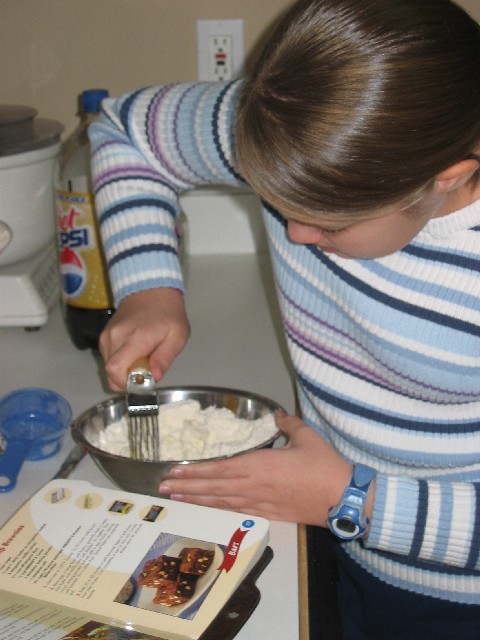
The kitchen staff busily prepared food for the event. Mary and I took charge of making the lemon bars; here Mary is cutting in shortening for Lemon Bars. We found an excellent recipe for these in the Hershey's Cocoa cookbook. Dee-licious!
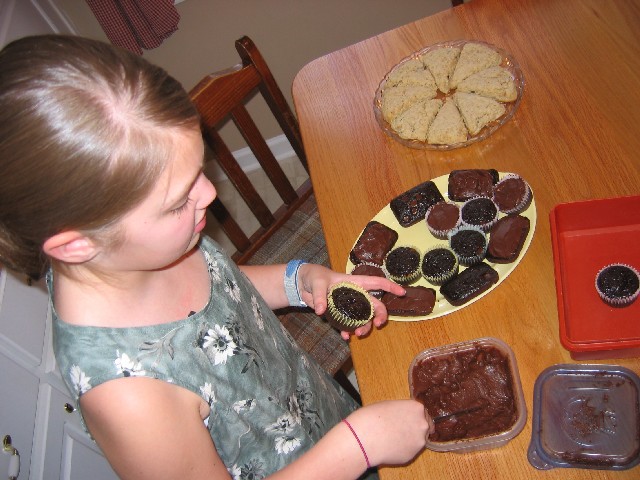
Mary frosted "muffins" in preparation for the tea party. We decided to call them muffins instead of cupcakes; it made them sound healthier ;). Both the icing and the "muffins" were mixed from scratch of course :), orchestrated by Hannah with various assistants.
(The photographer seemed to be prejudice towards pictures of Mary, but we won't fault him/her for this oversight. . . Although not well-documented, other members of the kitchen staff also contributed).

We're all decked out in pretty clothes and ready for the festivities to begin. Sarah and I get extra points for wearing hats :); Pretty hats are so much fun, especially for tea parties.

Sarah and I pause for a picture.

Susan, Hannah and Mary smile for the camera.

Passing round the goodies and pouring the tea. We were on our best manners and used British accents, of course! Many of our feigned conversations were remarkably reminiscent of period dramas like Pride and Prejudice or Wives and Daughters :).
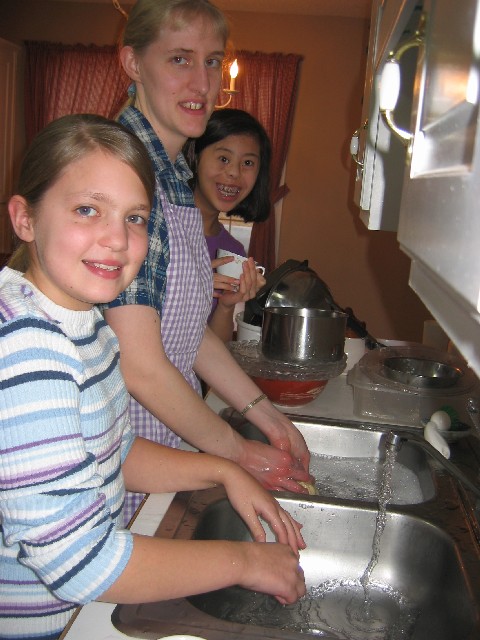
The "hired help" cleaned up after the tea guests were finished. Here the dish fairies pause to smile for the photographer.
All in all, it was a very fun and memorable event, and one that we hope can be repeated in the future :). What is it about tea parties that is so delightful?
Friday, February 03, 2006
Catechize your Children
Our shingles were replaced a few weeks ago, finally reversing the damage done by a hail storm early last year. The banging and clanging overhead was steady for a good bit of the day, starting at 7:30 (good thing I'm an early riser), and finally ending late afternoon. My mom, brother, and I were home for most of the day, enduring the noise. That morning, as I stepped out of the shower, I could hear, barely discernible above the noise of the roofing, my mom and brother conversing. They were in the living room sifting through my brother's things as he prepared to move to Seattle the next day (he's now living out there working for Evil Emperor Gates).
Because of the noise, I normally would not have been able to hear anything they were saying, except that it was something very familiar to me; I mentally zone in on familiar sayings or phrases even amid clamor. I have been known to discern the episode or scene - even the point in a conversation - of an Andy Griffith Show rerun from several rooms (or a floor) away, merely by the tones of voices and the background noises :).
My mom's voice: What befell our first parents when they had sinned?
I couldn't make out Ben's reply, as he was slightly farther away, but I mentally replied with him: Instead of being holy and happy, they became sinful and miserable.
When I emerged into the living room a few minutes later, I was in time for:
Q. Can any one go to heaven with this sinful nature?
A. No; our hearts must be changed before we can be fit for heaven.
"I thought I heard the catechism!" I exclaimed. Sure enough, my mom had pulled out my brother's old copy of The Catechism for Young Children and was testing his memory. Even after more than a decade, many of the questions were still fresh in his mind. I felt inspired to get out my own worn catechism, and I took a trip down memory lane as I reread the questions I had poured over and committed to memory so many years ago. I can still recall most of the answers, though the ones at the end of the catechism are a bit rusty.
My brother is only a year older than me, so we often had Sunday School together growing up. When we were respectively in 4th and 5th grade, we were together in Mrs. Thigpen's class (I also had Mrs. Thigpen in Kindergarten and then in 5th grade). Under the instruction of Mrs. Thigpen in Sunday School and my mother at home, Ben and I both memorized The Catechism for Young Children by the end of 5th grade, along with many memory verses that went along with the related Sunday School lesson. I still have my key chain full of colored, laminated memory verse cards, and I occasionally flip through them and recall them to my memory.
Let me stop here and say that catechetic instruction is rarely beneficial unless supported and propelled by parents in the home. I've mentioned before how important parental religious instruction is, and how sad it is that often Sunday Schools downplay parents' (particularly the father's) spiritual responsiblity to train their children. I believe that Sunday Schools and catechetic instruction should be in addition to (or impemented by) parents, particularly by fathers. The main reason the catechism proved beneficial for me was that my mom incorporated the catechism into homeschooling, as well as related activities. As one who has taught Sunday School, I can attest that it is very tough to have a lasting spiritual influence on children without the support and reinforcement of parents.
My old Sunday School teachers, Mr. and Mrs. Thigpen, founded Children's Ministry International a number of years ago; CMI is a non-profit organization that writes and publishes reformed children's curriculum based on The Catechism for Young Children and The Westminster Shorter Catechism; I recommend the CMI curriculum for anyone looking for a solid, Bible-based Sunday School or homeschool curriculum that is grounded in reformed principles, while presented at an introductory level. I learned the catechism in conjunction with the CMI curriculum.
Some of you may be scratching your heads at this point, as catechetic instruction is often associated with the Catholic church. The Catholics do not have a monopoly on the use of catechisms to train young children, however (and I do applaud their recognition of the importance of such instruction). Catechisms have been used for centuries, and continue to be used today, by protestants as well as Catholics to train the next generation in basic Biblical truths. Catechetic instruction is particularly favored in Catholic and reformed circles, although other groups also find such a method to be beneficial.
For those unfamiliar with catechetic instruction, perhaps a definition of a catechism would be helpful at this point. Here is the definition given by Webster's Dictionary:
The catechism I learned, The Catechism for Young Children, is a simplified version of The Westminster Shorter Catechism, which was written centuries ago by the Westminster Assembly of Divines. After learning The Catechism for Young Children, I did begin The Shorter Catechism, but only barely. I have since regretted not taking the time to commit The Shorter Catechism and its scripture proofs to memory (many catechisms, including The Shorter Catechism, contain reference Bible verses, called "scripture proofs", which are memorized along with the catechism questions).
As my attention to The Shorter Catechism was brief, to this day I only remember the first (and perhaps the most important) question in The Shorter Catechism:
Q: What is the chief end of man?
A: To glorify God and enjoy Him forever.
I would be hard-pressed to find a more excellent summary of a Christian's purpose and duty here on earth than the one given above. The purpose of a catechism is to instruct and train minds to be more like Christ as they learn to glorify God and enjoy Him forever.
Young children are like young plants, eager to drink in whatever food you feed them. What better food to feed them than the truths of God? Rather than (or at least in addition to) filling their young, impressionable minds with Sponge Bob, Mario Brothers, and Barney and Friends, fill their minds with the truths of God. It will not be in vain.
Proverbs 13:14 The teaching of the wise is a fountain of life, turning a man from the snares of death.
Catechetic instruction is not about brainwashing children to become Christians, or brainwashing them to become reformed, Catholic, or any other ideology. No instruction can make someone become a Christian; only the Holy Spirit can quicken a person's heart at the direction of the Father. Catechetic instruction is about instructing children in the way they should go, in the faith that God will draw them to Him in His timing. Parents are responsible for planting and watering seeds, but the growth is up to the Lord, lest we become prideful of our success.
Brad Winsted, the current director of CMI explains it this way: We are wiring the house of the child's mind and are waiting for the Holy Spirit to flick the switch translating the head knowledge to heart knowledge.
Many wonder why the catechism? Why not just have children memorize scripture? Wouldn't that be better, since scripture is the very Word of God, and any catechism is a human interpretation of the Word and therefore open to error.
At this point, I would like to offer the necessary disclaimer: I do not hold any catechism to have the same authority as the Word of God; as such, all catechisms (and creeds and confessions) should be tested in light of Scripture. When evaluating any man-made document we should be as Bereans, diligently searching the scriptures "to see if these things are so."
I am not discounting the importance of memorizing scripture. I highly encourage the memorization of scripture. Children have an especially easy time memorizing things, so by all means feed them scripture when they are young! The best catechetic instruction is coupled with scriptural references and memorizations; I have already mentioned scripture proofs that are often included in the catechism. The catechism is a companion to and an interpretation of scripture, not on par with scripture.
Every Christian parent uses some form of human interpretation to religiously instruct his child, whether it be verbal instruction, Bible storybooks, sermons, or even spiritual songs that are not part of the inspired psalms. It is inevitable to teach and instruct based on our own understanding of scripture. The Word of God is meant to be discussed, disected, and explained. No parent would allow his child's entire knowledge of God be exclusively based on direct reading of scripture. Since such training is inevitable, it is right and good to organize and solidify training into something the child will internalize. The catechism is systematic and organized. When properly implemented, it gives a child a structured basis for belief and an organized system from which to learn - sort of a "My First Systematic Theology" book. What a child internalizes becomes part of him, and he will carry it with him the rest of his life.
Here is an excerpt from an article written by Brad Winsted, director of CMI:
Now that I am older, I have the ability and desire to search out the truths I first learned at my parents' knees and between the covers of my catechism. At the time, I took what I was taught in faith, believing my parents and teachers. Now I can be a Berean, searching the scriptures to test what I was taught. By the grace of God I am continuing a journey that began at the feet of my parents, as they taught me the very basic truths of God.
For those further interested in catechetic instruction, I invite you to read the following articles on CMI's website:
Why Use the Children's Catechism Anyway?
A Personal Family Catechism
Why Bother Catechizing our Children?
It is worthwhile to be a Shorter Catechism boy. They grow to be men. And better than that, they are exceedingly apt to become men of God. - B.B. Warfield
Soli Deo Gloria
Because of the noise, I normally would not have been able to hear anything they were saying, except that it was something very familiar to me; I mentally zone in on familiar sayings or phrases even amid clamor. I have been known to discern the episode or scene - even the point in a conversation - of an Andy Griffith Show rerun from several rooms (or a floor) away, merely by the tones of voices and the background noises :).
My mom's voice: What befell our first parents when they had sinned?
I couldn't make out Ben's reply, as he was slightly farther away, but I mentally replied with him: Instead of being holy and happy, they became sinful and miserable.
When I emerged into the living room a few minutes later, I was in time for:
Q. Can any one go to heaven with this sinful nature?
A. No; our hearts must be changed before we can be fit for heaven.
"I thought I heard the catechism!" I exclaimed. Sure enough, my mom had pulled out my brother's old copy of The Catechism for Young Children and was testing his memory. Even after more than a decade, many of the questions were still fresh in his mind. I felt inspired to get out my own worn catechism, and I took a trip down memory lane as I reread the questions I had poured over and committed to memory so many years ago. I can still recall most of the answers, though the ones at the end of the catechism are a bit rusty.
My brother is only a year older than me, so we often had Sunday School together growing up. When we were respectively in 4th and 5th grade, we were together in Mrs. Thigpen's class (I also had Mrs. Thigpen in Kindergarten and then in 5th grade). Under the instruction of Mrs. Thigpen in Sunday School and my mother at home, Ben and I both memorized The Catechism for Young Children by the end of 5th grade, along with many memory verses that went along with the related Sunday School lesson. I still have my key chain full of colored, laminated memory verse cards, and I occasionally flip through them and recall them to my memory.
Let me stop here and say that catechetic instruction is rarely beneficial unless supported and propelled by parents in the home. I've mentioned before how important parental religious instruction is, and how sad it is that often Sunday Schools downplay parents' (particularly the father's) spiritual responsiblity to train their children. I believe that Sunday Schools and catechetic instruction should be in addition to (or impemented by) parents, particularly by fathers. The main reason the catechism proved beneficial for me was that my mom incorporated the catechism into homeschooling, as well as related activities. As one who has taught Sunday School, I can attest that it is very tough to have a lasting spiritual influence on children without the support and reinforcement of parents.
My old Sunday School teachers, Mr. and Mrs. Thigpen, founded Children's Ministry International a number of years ago; CMI is a non-profit organization that writes and publishes reformed children's curriculum based on The Catechism for Young Children and The Westminster Shorter Catechism; I recommend the CMI curriculum for anyone looking for a solid, Bible-based Sunday School or homeschool curriculum that is grounded in reformed principles, while presented at an introductory level. I learned the catechism in conjunction with the CMI curriculum.
Some of you may be scratching your heads at this point, as catechetic instruction is often associated with the Catholic church. The Catholics do not have a monopoly on the use of catechisms to train young children, however (and I do applaud their recognition of the importance of such instruction). Catechisms have been used for centuries, and continue to be used today, by protestants as well as Catholics to train the next generation in basic Biblical truths. Catechetic instruction is particularly favored in Catholic and reformed circles, although other groups also find such a method to be beneficial.
For those unfamiliar with catechetic instruction, perhaps a definition of a catechism would be helpful at this point. Here is the definition given by Webster's Dictionary:
CATECHISM, n.
1. A form of instruction by means of questions and answers, particularly in the principles of religion.
2. An elementary book containing a summary of principles in any science or art, but appropriately in religion, reduced to the form of questions and answers, and sometimes with notes, explanations, and references to authorities.
The catechism I learned, The Catechism for Young Children, is a simplified version of The Westminster Shorter Catechism, which was written centuries ago by the Westminster Assembly of Divines. After learning The Catechism for Young Children, I did begin The Shorter Catechism, but only barely. I have since regretted not taking the time to commit The Shorter Catechism and its scripture proofs to memory (many catechisms, including The Shorter Catechism, contain reference Bible verses, called "scripture proofs", which are memorized along with the catechism questions).
As my attention to The Shorter Catechism was brief, to this day I only remember the first (and perhaps the most important) question in The Shorter Catechism:
Q: What is the chief end of man?
A: To glorify God and enjoy Him forever.
I would be hard-pressed to find a more excellent summary of a Christian's purpose and duty here on earth than the one given above. The purpose of a catechism is to instruct and train minds to be more like Christ as they learn to glorify God and enjoy Him forever.
Young children are like young plants, eager to drink in whatever food you feed them. What better food to feed them than the truths of God? Rather than (or at least in addition to) filling their young, impressionable minds with Sponge Bob, Mario Brothers, and Barney and Friends, fill their minds with the truths of God. It will not be in vain.
Proverbs 13:14 The teaching of the wise is a fountain of life, turning a man from the snares of death.
Catechetic instruction is not about brainwashing children to become Christians, or brainwashing them to become reformed, Catholic, or any other ideology. No instruction can make someone become a Christian; only the Holy Spirit can quicken a person's heart at the direction of the Father. Catechetic instruction is about instructing children in the way they should go, in the faith that God will draw them to Him in His timing. Parents are responsible for planting and watering seeds, but the growth is up to the Lord, lest we become prideful of our success.
Brad Winsted, the current director of CMI explains it this way: We are wiring the house of the child's mind and are waiting for the Holy Spirit to flick the switch translating the head knowledge to heart knowledge.
Many wonder why the catechism? Why not just have children memorize scripture? Wouldn't that be better, since scripture is the very Word of God, and any catechism is a human interpretation of the Word and therefore open to error.
At this point, I would like to offer the necessary disclaimer: I do not hold any catechism to have the same authority as the Word of God; as such, all catechisms (and creeds and confessions) should be tested in light of Scripture. When evaluating any man-made document we should be as Bereans, diligently searching the scriptures "to see if these things are so."
I am not discounting the importance of memorizing scripture. I highly encourage the memorization of scripture. Children have an especially easy time memorizing things, so by all means feed them scripture when they are young! The best catechetic instruction is coupled with scriptural references and memorizations; I have already mentioned scripture proofs that are often included in the catechism. The catechism is a companion to and an interpretation of scripture, not on par with scripture.
Every Christian parent uses some form of human interpretation to religiously instruct his child, whether it be verbal instruction, Bible storybooks, sermons, or even spiritual songs that are not part of the inspired psalms. It is inevitable to teach and instruct based on our own understanding of scripture. The Word of God is meant to be discussed, disected, and explained. No parent would allow his child's entire knowledge of God be exclusively based on direct reading of scripture. Since such training is inevitable, it is right and good to organize and solidify training into something the child will internalize. The catechism is systematic and organized. When properly implemented, it gives a child a structured basis for belief and an organized system from which to learn - sort of a "My First Systematic Theology" book. What a child internalizes becomes part of him, and he will carry it with him the rest of his life.
Here is an excerpt from an article written by Brad Winsted, director of CMI:
Let me tell you a true story about a Presbyterian pastor who was asking a Catholic priest about why so many Catholics, when they are older and have been away from church so long, seem to want to come back. The Catholic priest's answer was immediate. "We catechize our little children and it is part of them, therefore, when they are seeking again the answers to life, their memorized catechism questions come back to them and they return again to the source of that learning.".I still refer back to many things I learned as a young girl studying the catechism. The solid Biblical truths I learned come back to me unprompted because they are part of me. To me, sin will always be want of conformity unto or transgression of the law of God. It was through the catechism that I first internalized the realization that sin has two aspects: not being and doing what God requires and doing what God forbids. That is something I will never, ever forget.
Now that I am older, I have the ability and desire to search out the truths I first learned at my parents' knees and between the covers of my catechism. At the time, I took what I was taught in faith, believing my parents and teachers. Now I can be a Berean, searching the scriptures to test what I was taught. By the grace of God I am continuing a journey that began at the feet of my parents, as they taught me the very basic truths of God.
For those further interested in catechetic instruction, I invite you to read the following articles on CMI's website:
Why Use the Children's Catechism Anyway?
A Personal Family Catechism
Why Bother Catechizing our Children?
It is worthwhile to be a Shorter Catechism boy. They grow to be men. And better than that, they are exceedingly apt to become men of God. - B.B. Warfield
Soli Deo Gloria
Sunday, January 29, 2006
Under Grace, Part II
Read my first post on grace here.
In yesterday's post on grace, I mentioned the two aspects of grace that we, as believers, are extended. Not only are we forgiven of our sins, but we are continually cleansed and purified by the Holy Spirit. I also highlighted v. 14 of Romans 6, which is oft' misquoted as a prooftext for antinomianism, and I explained why such a use of the verse is mistaken and completely out of context.
At the end of yesterday's post, I had considered expounding more on law v. grace, but decide to hold off, hoping that I would have the chance in the future (The three chickens on the stove were calling my name; I now have plenty of broth for your soup recipe, Jessica!). One reason I held off on extending my previous post was because I was still mulling over several related ideas and had not yet sorted them out in my brain. I'm still sorting, but I feel more organized in my thoughts on the matter today than I did yesterday. The sermon today had many applications to areas over which I was ruminating; it was definitely a timely choice of sermon topic. A good portion of this second post will be drawn from this morning's sermon.
I tend towards extremes. I don't live by the ebb and flow of our culture or even of the modern church, but do you know what? I fall into many pitfalls even as I am careful to protect myself from modernist views. I exchange one sin for another. You see, I am often so careful to avoid all the "evils of modern society", making sure to avoid those sins that I deem "really bad." However, in backing away in disgust from modernism and antinomianism, I stumble and fall into separatism and legalism. I exchange one extreme for another.
I think we all have problems with such extremes. As one of my former pastors would say, I know I am guilty of _______, and you can't be that much better! It's much easier to whole-heartedly embrace either antinomianism or legalism, rather than striking a balance between the two. Conservatives, homeschoolers especially :), have a special knack at card-carrying legalism.
The sermon at our church this morning was from Mark, chapter 7, verses 1-13. This passage really strikes an excellent balance with Romans 6; Mark 7 stabs legalism, while Roman 6 attacks antinomianism. Both legalism and antinomianism are easy to fall into, and I am pretty confident that every Christian struggles with both to some extent; some may major on legalism and minor on antinomianism, while others may do the reverse, but I don't believe there ever was or ever will be a Christian who hasn't dabbled in a combination of the two.
The passage from Mark 7 details Jesus' condemnation of the Pharisaical traditions. We all know that the Pharisees majored on legalism, but I think they also had a strong minor in antinomianism, however covert they wished it to be. In this passage, Jesus takes a swing at their failings in both areas.
The Pharisees were experts at keeping the law, if there ever were experts. They not only strived to keep the whole law of Moses, they even embellished the Mosaic law to make sure they didn't come close to breaking it. This was called "fencing the law." Fencing the law was the practice of placing safety nets over the Mosaic law, to doubly ensure that it was not broken. For example, to ensure that God's name was never taken in vain, God's favorite name - Yahweh or Jehovah, meaning "I am" - was not spoken for hundreds of years. The Jewish people figured that if they never spoke God's name, they could never profane it. In like manner, they adopted hundreds of extra-scriptural rules concerning Sabbath-keeping, to absolutely ensure that the Sabbath was strictly kept.
The problem was that the Pharisees treated their own rules, or boundaries for the law, as absolute laws, not "helpful suggestions." They were trusting in their system of righteousness to save them, trying to clean themselves up before God, rather than letting Him do the job.
We can laugh at the Pharisees and their fencing of the law, but are we not also guilty of the same thing? I know I am. I appreciate R.C. Sproul Jr.'s principle of hermeneutics: When you read in the Bible of someone doing something stupid, do not say "How can they be that stupid?" Instead, think, "How am I that stupid?" After all, original sin isn't all that original; we make the same mistakes that our fathers did and that our forefathers did. We should study our past, not to make fun of our forebearers, but to learn from their mistakes. As the old addage goes, those who don't learn history are doomed to repeat it.
Fencing the law is not a dead practice; it's alive and well. We see lawlessness, we see filth, and we build extra safeguards to avoid it. It's much easier to confront sin with specific rules and regulations, rather than with a guiding principle, so when such specific rules are absent from scripture, we make our own for convenience's sake. A few cases in point:
Clothing: Those of us who recognize (rightly so) the vast problems with our culture's general mode of undress are anxious to do something about this problem. Unfortunately it is easier to fall into establishing certain rules regarding apparel and then inflict them on others than it is to teach and practice guiding principles of modesty and propriety with regards to clothing. It's much easier to tell a girl that her skirt is too short because it doesn't reach her knee then it is to explain to her exactly what a miniskirt does to her brothers in Christ. It's also easier, when aware of modern problems in blurring gender roles, to "solve" this problem by appointing skirts as the only godly apparel for women. Detailing reasons behind such a practice or explaining the problems with dressing with no gender distinction would take much more effort, so we establish specific, extra-Biblical rules on the matter. (For my own views on feminine apparel, please see this post I wrote on the subject last fall.)
Entertainment: Those of us who recognize (rightly so) the vast problems with our culture's general methods of entertainment are anxious to do something about this problem. Unfortunately it is easier to establish certain rules regarding entertainment and then inflict them on others, rather than teach and practice guiding principles of time management and mental purity. (Sensing a strong parallel to the previous paragraph?) It's easier to decide that all R rated movies are wrong, rather than evalate each movie based on Biblical principles; it's easier still to dismiss all TV and cinema as ungodly. It's much easier to tell someone that all video games are wrong because they are a waste of time, rather than provide that same someone with reasons that time is important and then provide alternatives for both entertainment and industry.
Education: Those of us who recognize (rightly so) the vast problems with our culture's general methods of education are anxious to do something about this problem. Unfortunately it is easier to establish certain rules regarding education and then inflict them on others, rather than teach and practice guiding principles of wise educational decisions and godly training. (Sensing a strong parallel to the previous two paragraphs?) It's easier to declare that homeschooling is the only method of education allowable to Christian parents, rather than explain legitimate, Biblical problems with the public school system and the majority of Christian schools. How much easier is it to condemn all college education as "wasteful," "sinful," and "prideful," rather than taking the time to explain many legitimate concerns with the typical college education?
The problem with all of the above examples is that in each one, a man-made rule is established and instigated with the assumed authority of God. Many views somewhere in the middle of the "condemned view" and the "godly view", that may indeed be legitimately Biblical, are automatically thrown out in exchange for a man-made definition of righteousness.
I could go on, expounding on courtship, sexual purity, birth control, music, age-segregated activities, debt, child-rearing strategies, etc. I could continue, but I'm sure I've painted a large enough picture :). I've brushed enough strokes on the subject to keep myself, and I'm sure each of you, reeling from conviction for years to come. Many of the scenarios I described above I am guilty of perpetuating. As I recoil from antinomianism I fall into legalism, over and over. It really is a slimy pit out of which God continues to pull me. I fall into a form of legalism; God delivers me. I fall right into another form; God delivers me. Et Cetera. Sanctification is definitely a continual process!
The Pharisees were using their traditions to make themselves good, to earn their righteous status. They were using their ceremonial traditions of cleansing, not so much to cleanse their feet and hands and bowls, as much as they were using their traditions to try to cleanse their consciences. They were trying to save themselves by good deeds.
The law of God is good and right; we are to delight in the law of God; we are to love the law of God; we are to cherish the law of God; we are to seek to follow the law of God. Legalism distorts the law of God, though. The law of God is given by God to "teach us our duty, and show our need of a Saviour" (courtesy of the Catechism for Young Children). It is a mirror into which we look to see our filth before God; the law shows us our sin. The law is not the solution to the problem; it is there to show us the problem! I love the way the pastor put it this morning: The law is a mirror to show us what's wrong. The law is not soap, so quit scrubbing yourself with it!
That is the problem with legalism; we treat the law like soap, using it to try to cleanse ourselves and make us right before God. It's a works-based salvation, destroying the significance of Jesus' sacrifice on the cross and the continuing role of sanctification that the Holy Spirit is appointed to do in our lives.
The Pharisees were genuine legalists. How then were they also antinomians? Well, the Pharisees sure had a lot of laws down pat; they washed at the right times, they rested properly on the Sabbath, and they avoided unclean meat. But like we all do, they played pick-and-choose when it came to the law. I like this law here, hmmm, nope chuck that law, this one will do, let's add in this one right here just to make sure. . . Take a look at vv. 9-13 for an example.
Are we not all guilty of playing pick-and-choose with the law? We pick certain commands of God that we deem "really important" - usually ones that happen to come easily for us (hmmm. . . ), we "overlook" some other commands of God that "aren't as important" or are a "matter of personal conviction," and then to make ourselves feel really good we make up a few rules of our own to ensure our own righteousness. Then we top it all off by finding people who haven't decided on the exact same result in our "pick-and-choose" game, and set about condemning them in an attitude of self-righteousness.
Antinomianism ignores the second dimension of grace - sanctification, while legalism ignores the first dimension - justification by faith alone. The two dogmas, while seemingly unrelated, are quite intimately connected. May God deliver me - and all of us - from both of these traps.
In yesterday's post on grace, I mentioned the two aspects of grace that we, as believers, are extended. Not only are we forgiven of our sins, but we are continually cleansed and purified by the Holy Spirit. I also highlighted v. 14 of Romans 6, which is oft' misquoted as a prooftext for antinomianism, and I explained why such a use of the verse is mistaken and completely out of context.
At the end of yesterday's post, I had considered expounding more on law v. grace, but decide to hold off, hoping that I would have the chance in the future (The three chickens on the stove were calling my name; I now have plenty of broth for your soup recipe, Jessica!). One reason I held off on extending my previous post was because I was still mulling over several related ideas and had not yet sorted them out in my brain. I'm still sorting, but I feel more organized in my thoughts on the matter today than I did yesterday. The sermon today had many applications to areas over which I was ruminating; it was definitely a timely choice of sermon topic. A good portion of this second post will be drawn from this morning's sermon.
I tend towards extremes. I don't live by the ebb and flow of our culture or even of the modern church, but do you know what? I fall into many pitfalls even as I am careful to protect myself from modernist views. I exchange one sin for another. You see, I am often so careful to avoid all the "evils of modern society", making sure to avoid those sins that I deem "really bad." However, in backing away in disgust from modernism and antinomianism, I stumble and fall into separatism and legalism. I exchange one extreme for another.
I think we all have problems with such extremes. As one of my former pastors would say, I know I am guilty of _______, and you can't be that much better! It's much easier to whole-heartedly embrace either antinomianism or legalism, rather than striking a balance between the two. Conservatives, homeschoolers especially :), have a special knack at card-carrying legalism.
The sermon at our church this morning was from Mark, chapter 7, verses 1-13. This passage really strikes an excellent balance with Romans 6; Mark 7 stabs legalism, while Roman 6 attacks antinomianism. Both legalism and antinomianism are easy to fall into, and I am pretty confident that every Christian struggles with both to some extent; some may major on legalism and minor on antinomianism, while others may do the reverse, but I don't believe there ever was or ever will be a Christian who hasn't dabbled in a combination of the two.
The passage from Mark 7 details Jesus' condemnation of the Pharisaical traditions. We all know that the Pharisees majored on legalism, but I think they also had a strong minor in antinomianism, however covert they wished it to be. In this passage, Jesus takes a swing at their failings in both areas.
The Pharisees were experts at keeping the law, if there ever were experts. They not only strived to keep the whole law of Moses, they even embellished the Mosaic law to make sure they didn't come close to breaking it. This was called "fencing the law." Fencing the law was the practice of placing safety nets over the Mosaic law, to doubly ensure that it was not broken. For example, to ensure that God's name was never taken in vain, God's favorite name - Yahweh or Jehovah, meaning "I am" - was not spoken for hundreds of years. The Jewish people figured that if they never spoke God's name, they could never profane it. In like manner, they adopted hundreds of extra-scriptural rules concerning Sabbath-keeping, to absolutely ensure that the Sabbath was strictly kept.
The problem was that the Pharisees treated their own rules, or boundaries for the law, as absolute laws, not "helpful suggestions." They were trusting in their system of righteousness to save them, trying to clean themselves up before God, rather than letting Him do the job.
We can laugh at the Pharisees and their fencing of the law, but are we not also guilty of the same thing? I know I am. I appreciate R.C. Sproul Jr.'s principle of hermeneutics: When you read in the Bible of someone doing something stupid, do not say "How can they be that stupid?" Instead, think, "How am I that stupid?" After all, original sin isn't all that original; we make the same mistakes that our fathers did and that our forefathers did. We should study our past, not to make fun of our forebearers, but to learn from their mistakes. As the old addage goes, those who don't learn history are doomed to repeat it.
Fencing the law is not a dead practice; it's alive and well. We see lawlessness, we see filth, and we build extra safeguards to avoid it. It's much easier to confront sin with specific rules and regulations, rather than with a guiding principle, so when such specific rules are absent from scripture, we make our own for convenience's sake. A few cases in point:
Clothing: Those of us who recognize (rightly so) the vast problems with our culture's general mode of undress are anxious to do something about this problem. Unfortunately it is easier to fall into establishing certain rules regarding apparel and then inflict them on others than it is to teach and practice guiding principles of modesty and propriety with regards to clothing. It's much easier to tell a girl that her skirt is too short because it doesn't reach her knee then it is to explain to her exactly what a miniskirt does to her brothers in Christ. It's also easier, when aware of modern problems in blurring gender roles, to "solve" this problem by appointing skirts as the only godly apparel for women. Detailing reasons behind such a practice or explaining the problems with dressing with no gender distinction would take much more effort, so we establish specific, extra-Biblical rules on the matter. (For my own views on feminine apparel, please see this post I wrote on the subject last fall.)
Entertainment: Those of us who recognize (rightly so) the vast problems with our culture's general methods of entertainment are anxious to do something about this problem. Unfortunately it is easier to establish certain rules regarding entertainment and then inflict them on others, rather than teach and practice guiding principles of time management and mental purity. (Sensing a strong parallel to the previous paragraph?) It's easier to decide that all R rated movies are wrong, rather than evalate each movie based on Biblical principles; it's easier still to dismiss all TV and cinema as ungodly. It's much easier to tell someone that all video games are wrong because they are a waste of time, rather than provide that same someone with reasons that time is important and then provide alternatives for both entertainment and industry.
Education: Those of us who recognize (rightly so) the vast problems with our culture's general methods of education are anxious to do something about this problem. Unfortunately it is easier to establish certain rules regarding education and then inflict them on others, rather than teach and practice guiding principles of wise educational decisions and godly training. (Sensing a strong parallel to the previous two paragraphs?) It's easier to declare that homeschooling is the only method of education allowable to Christian parents, rather than explain legitimate, Biblical problems with the public school system and the majority of Christian schools. How much easier is it to condemn all college education as "wasteful," "sinful," and "prideful," rather than taking the time to explain many legitimate concerns with the typical college education?
The problem with all of the above examples is that in each one, a man-made rule is established and instigated with the assumed authority of God. Many views somewhere in the middle of the "condemned view" and the "godly view", that may indeed be legitimately Biblical, are automatically thrown out in exchange for a man-made definition of righteousness.
I could go on, expounding on courtship, sexual purity, birth control, music, age-segregated activities, debt, child-rearing strategies, etc. I could continue, but I'm sure I've painted a large enough picture :). I've brushed enough strokes on the subject to keep myself, and I'm sure each of you, reeling from conviction for years to come. Many of the scenarios I described above I am guilty of perpetuating. As I recoil from antinomianism I fall into legalism, over and over. It really is a slimy pit out of which God continues to pull me. I fall into a form of legalism; God delivers me. I fall right into another form; God delivers me. Et Cetera. Sanctification is definitely a continual process!
The Pharisees were using their traditions to make themselves good, to earn their righteous status. They were using their ceremonial traditions of cleansing, not so much to cleanse their feet and hands and bowls, as much as they were using their traditions to try to cleanse their consciences. They were trying to save themselves by good deeds.
The law of God is good and right; we are to delight in the law of God; we are to love the law of God; we are to cherish the law of God; we are to seek to follow the law of God. Legalism distorts the law of God, though. The law of God is given by God to "teach us our duty, and show our need of a Saviour" (courtesy of the Catechism for Young Children). It is a mirror into which we look to see our filth before God; the law shows us our sin. The law is not the solution to the problem; it is there to show us the problem! I love the way the pastor put it this morning: The law is a mirror to show us what's wrong. The law is not soap, so quit scrubbing yourself with it!
That is the problem with legalism; we treat the law like soap, using it to try to cleanse ourselves and make us right before God. It's a works-based salvation, destroying the significance of Jesus' sacrifice on the cross and the continuing role of sanctification that the Holy Spirit is appointed to do in our lives.
The Pharisees were genuine legalists. How then were they also antinomians? Well, the Pharisees sure had a lot of laws down pat; they washed at the right times, they rested properly on the Sabbath, and they avoided unclean meat. But like we all do, they played pick-and-choose when it came to the law. I like this law here, hmmm, nope chuck that law, this one will do, let's add in this one right here just to make sure. . . Take a look at vv. 9-13 for an example.
Are we not all guilty of playing pick-and-choose with the law? We pick certain commands of God that we deem "really important" - usually ones that happen to come easily for us (hmmm. . . ), we "overlook" some other commands of God that "aren't as important" or are a "matter of personal conviction," and then to make ourselves feel really good we make up a few rules of our own to ensure our own righteousness. Then we top it all off by finding people who haven't decided on the exact same result in our "pick-and-choose" game, and set about condemning them in an attitude of self-righteousness.
Antinomianism ignores the second dimension of grace - sanctification, while legalism ignores the first dimension - justification by faith alone. The two dogmas, while seemingly unrelated, are quite intimately connected. May God deliver me - and all of us - from both of these traps.
Saturday, January 28, 2006
Stay-At-Home Wives
I found this article to be inspiring. There are many excellent articles out there on stay-at-home mothers (some of which I have linked in the past), but few on stay-at-home wives. I hope the article inspires you as it did me.
Hattip: Lady Lydia's blog
Hattip: Lady Lydia's blog
Under Grace
I've been thinking about grace a lot in the past few weeks. My mom and I are in a women's Bible study at our church this spring, and we are going through Grace to Stand Firm, Grace to Grow, by Carol J. Ruvolo. As evidenced by the title, the study is on grace, more specifically Peter's perspective on grace in I Peter.
I realized that I've been confusing grace and mercy and sort of lumping them together even though they are different. One lady at the study on Tuesday described grace and mercy this way: Grace is giving to someone what he doesn't deserve, while mercy is not dealing to someone what he justly deserves.
I like D. James Kennedy's simple yet profound definition of grace: God's riches at Christ's expense. Jerry Bridges described grace as God's free and unmerited favor shown to guilty sinners who deserve only judgment. To put it personally, I, who was once poor in my filthy rags of sin, have been clothed with the righteousness of Christ.
I think it is easy to see grace as a one-time deal; we "make a decision", Jesus comes into our heart, and extends grace to forgive our sins. What we tend to miss is that grace is also a continual process, a renewal and a sanctification. Jerry Bridges recognized two dimensions of grace: God's free and unmerited favor that is granted to us by salvation, and a continual sanctification by the Holy Spirit, as an ongoing release from the bonds of sin.
When we are saved by God's mercy and favor, the journey has only just begun! God is not finished with us, and he will continue to remold and refine us to become more and more like Him. Romans 6 is an excellent passage on righteousness and sin. I memorized Romans 6 a few years ago, but unfortunately it has mostly flown the coop, so I was reviewing it and recommitting it to memory today.
(As a side note, does anyone have advice on memorizing scripture and having it "stick"? I can memorize a whole chapter of scripture in a day or two if I press myself, but it doesn't last, even with continual rehearsing for several days or weeks. A few weeks of no exposure to the passage, and it's mostly gone. When I was younger, scripture - and the catechism - just stuck in my brain with very little effort. I still remember scores of verses and catechism questions that I memorized in elementary school but haven't rehearsed in years. I think my myelin sheaths are wearing down. . . )
The aforementioned passage is an entreaty to continually die to sin and walk in newness of life (v. 4). We know that our old self was crucified with him in order that the body of sin might be brought to nothing, so that we would no longer be enslaved to sin (v. 6). The first 13 verses of the passage continually expound on the truth of our death with Christ and our resurrection with Him. Verses 15-23 carry the same message as the earlier ones.
Stuck right in the middle is v. 14:
For sin will have no dominion over you, since you are not under law but under grace.
Verse 14 is one of the most oft' mis-quoted portions of scripture. Reading it in context today, I was especially struck by the irony of its use as a proof text for antinomianism. The verse is surrounded by a treatise to righteousness, to continued sanctification. We are not under the weight and the guilt of the law, but we are slaves to righteousness (vv. 16, 18, 19, 22)!
Paul even answers the antinomians of his day, first at the beginning of the chapter, then immediately after v. 14:
What shall we say then? Are we to continue in sin that grace may abound? By no means! How can we who died to sin still live in it? (vv. 1,2 )
What then? Are we to sin because we are not under law but under grace? By no means! Do you not know that if you present yourselves to anyone as obedient slaves, you are slaves of the one whom you obey, either of sin, which leads to death, or of obedience, which leads to righteousness? (vv. 15, 16)
We are slaves of righteousness! Our guilt is gone and we are free from sin in Christ, even as we are slaves of righteousness. We are no longer under the weight of the law (v. 14) but that does not mean we can do "whatever we want" just because our eternity is secure. I was saved (justification), I am being saved (sanctification), and I will be saved (glorification). Thanks be to God!
I realized that I've been confusing grace and mercy and sort of lumping them together even though they are different. One lady at the study on Tuesday described grace and mercy this way: Grace is giving to someone what he doesn't deserve, while mercy is not dealing to someone what he justly deserves.
I like D. James Kennedy's simple yet profound definition of grace: God's riches at Christ's expense. Jerry Bridges described grace as God's free and unmerited favor shown to guilty sinners who deserve only judgment. To put it personally, I, who was once poor in my filthy rags of sin, have been clothed with the righteousness of Christ.
I think it is easy to see grace as a one-time deal; we "make a decision", Jesus comes into our heart, and extends grace to forgive our sins. What we tend to miss is that grace is also a continual process, a renewal and a sanctification. Jerry Bridges recognized two dimensions of grace: God's free and unmerited favor that is granted to us by salvation, and a continual sanctification by the Holy Spirit, as an ongoing release from the bonds of sin.
When we are saved by God's mercy and favor, the journey has only just begun! God is not finished with us, and he will continue to remold and refine us to become more and more like Him. Romans 6 is an excellent passage on righteousness and sin. I memorized Romans 6 a few years ago, but unfortunately it has mostly flown the coop, so I was reviewing it and recommitting it to memory today.
(As a side note, does anyone have advice on memorizing scripture and having it "stick"? I can memorize a whole chapter of scripture in a day or two if I press myself, but it doesn't last, even with continual rehearsing for several days or weeks. A few weeks of no exposure to the passage, and it's mostly gone. When I was younger, scripture - and the catechism - just stuck in my brain with very little effort. I still remember scores of verses and catechism questions that I memorized in elementary school but haven't rehearsed in years. I think my myelin sheaths are wearing down. . . )
The aforementioned passage is an entreaty to continually die to sin and walk in newness of life (v. 4). We know that our old self was crucified with him in order that the body of sin might be brought to nothing, so that we would no longer be enslaved to sin (v. 6). The first 13 verses of the passage continually expound on the truth of our death with Christ and our resurrection with Him. Verses 15-23 carry the same message as the earlier ones.
Stuck right in the middle is v. 14:
For sin will have no dominion over you, since you are not under law but under grace.
Verse 14 is one of the most oft' mis-quoted portions of scripture. Reading it in context today, I was especially struck by the irony of its use as a proof text for antinomianism. The verse is surrounded by a treatise to righteousness, to continued sanctification. We are not under the weight and the guilt of the law, but we are slaves to righteousness (vv. 16, 18, 19, 22)!
Paul even answers the antinomians of his day, first at the beginning of the chapter, then immediately after v. 14:
What shall we say then? Are we to continue in sin that grace may abound? By no means! How can we who died to sin still live in it? (vv. 1,2 )
What then? Are we to sin because we are not under law but under grace? By no means! Do you not know that if you present yourselves to anyone as obedient slaves, you are slaves of the one whom you obey, either of sin, which leads to death, or of obedience, which leads to righteousness? (vv. 15, 16)
We are slaves of righteousness! Our guilt is gone and we are free from sin in Christ, even as we are slaves of righteousness. We are no longer under the weight of the law (v. 14) but that does not mean we can do "whatever we want" just because our eternity is secure. I was saved (justification), I am being saved (sanctification), and I will be saved (glorification). Thanks be to God!
Friday, January 27, 2006
Calling All Soup Recipes
As I mentioned here, here, and here, I infinitely prefer from-scratch cooking to any of various stages of prepared foods. It's often a challenge to even find good from-scratch recipes, so we're always on the lookout for good ones. My Dear Sister has been after me for several days to post a request for soup recipes. We love soup in the wintertime but much prefer soup that is homemade. So, if you have a favorite from-scratch soup recipe, Hannah and I would be thrilled if you'd share it with us :).
Here are directions for one of our favorite soups. It's great for using up leftover mashed potatoes. Use mashed potatoes made with potato peels to give the soup an extra dimension and to add nutrition. It's kind of a little-of-this, little-of-that recipe, but aren't those always the best kind?
Potato Soup
Chop up a little bit of celery and onion and place in a saucepan with about 1/3 cup water. Cook 5-10 minutes until tender. Add leftover mashed potatoes and milk to desired consistency. Salt and pepper to taste. Serve with cheddar cheese sprinkled on top.
Here are directions for one of our favorite soups. It's great for using up leftover mashed potatoes. Use mashed potatoes made with potato peels to give the soup an extra dimension and to add nutrition. It's kind of a little-of-this, little-of-that recipe, but aren't those always the best kind?
Potato Soup
Chop up a little bit of celery and onion and place in a saucepan with about 1/3 cup water. Cook 5-10 minutes until tender. Add leftover mashed potatoes and milk to desired consistency. Salt and pepper to taste. Serve with cheddar cheese sprinkled on top.
Sunday, January 22, 2006
The Garden
I read this story a number of years ago, promptly forgot the source, and had not been able to locate it again until this evening when I stumbled upon it while browsing the YLCF site. Now I remember that I first read it in the back of a Douglas Wilson book (Her Hand in Marriage perhaps?). Enjoy.
The Garden by Douglas Wilson
As my horse trotted wearily up the road, I could see the walls of a beautiful garden ahead. Outside the gate was an equally beautiful woman. At the sound of my greeting, she turned and dropped a curtsey. "Good sir... good morning."
I looked at her, and then at the garden walls extending out to the right and left. Behind her was the garden gate. I said, "I am very thirsty...for something clean." She smiled, and her smile made me thirstier still. But she said nothing. "Is there water here?" I asked.
"There is a stream within my garden." Her statement was simply a statement of fact; there was no invitation at all in it.
I asked, "May I come in and drink?"
"No," she said. "The lord of my mother's garden does not permit that."
"Why is this? Other women have let me drink from the gardens that they tend." I glanced at the fruit-laden branches, which were visible over the top of the garden wall. "You have a lovely garden, but those who let me drink had gardens just as beautiful."
She laughed at this, and her laugh was merry indeed. "I have no doubt that you have been in some lovely gardens. But was the water clean?"
"No," I said, and in spite of myself, turned my head and looked down.
She continued with a question. "Is that why you are no longer in the gardens tended by these women?"
I was ashamed so I did not answer her. Instead I looked past her into the garden. The path through the gate disappeared after a few feet, leaving the view of anyone on the road. "It seems like a shame for such a garden to go to waste."
She seemed both puzzled and amused. "How does it go to waste?"
"Does any man drink from your stream?"
"No, but no man fouls it either."
"But is that not a waste? Was not your stream made to quench the thirst of travelers?"
"I'm afraid you are seriously mistaken. It was made to quench the thirst, not of travelers, but of the lord of the garden."
"Oh," I said, "this garden has a lord?"
"No," she said.
"Then I don't understand. Are you speaking in riddles?"
She smiled. "No, I do not. The garden will one day have a lord, although it does not yet. The stream is for him alone."
"And who will your lord be?"
"When my mother's lord gives a blessing, the one whom I appoint."
"How can the lesser appoint the greater?"
"How can it not be so? When my lord comes, I will grant to him my garden. But until I do, he is just another traveler."
"And what do you look for? I am sure there are many who knock at your gate."
At this she blushed slightly but looked straight at me. "I will not have a lord who does not have a lord himself--my lord must have taken an oath of fealty to the Landlord."
"The Landlord? Who is he?"
"He is the owner of all the gardens along this road. In order to come into my garden, my lord must take an oath before the Landlord to tend the garden well. He must also swear that he will enter no other garden."
I had never heard such words as these before. "How long must he stay out of other gardens?"
"Forever."
"But what if he is born to travel?"
"Then he is not born for my garden."
"I see," I said, becoming a little angry. "Then why have I never heard of such an oath? I have been in many gardens."
"Yes, you said that before. But was the water clean? Were the gardens tended? That is what happens when there is no oath."
"So that is all? If someone takes an oath before this Landlord, you will make them your Lord?"
"No."
"Well, what else then?"
"There are many men who think they can tend my garden well, and who would be willing to swear an oath before the Landlord saying so. But that does not mean that my mother's lord, or I, share their confidence."
"What do you mean?"
"I mean that I know the extent of the garden. I have a knowledge of it that cannot be gained from the road. But no man can share that knowledge until after I have made him my lord and husband. So I must have the measure of the man before."
"So what must a man do?"
"The first thing is to--"
"Yes, I know. He must swear to the Landlord. But after?"
"He must return to me, and ask to see my mother's lord."
"And what would he say?"
"That depends on the man."
At this parting comment, she turned and walked slowly back into the garden, pulling the gate closed behind her. I spurred my horse, which began to trot down the road. I did not know what to think, but I needed to find this Landlord.
The Garden by Douglas Wilson
As my horse trotted wearily up the road, I could see the walls of a beautiful garden ahead. Outside the gate was an equally beautiful woman. At the sound of my greeting, she turned and dropped a curtsey. "Good sir... good morning."
I looked at her, and then at the garden walls extending out to the right and left. Behind her was the garden gate. I said, "I am very thirsty...for something clean." She smiled, and her smile made me thirstier still. But she said nothing. "Is there water here?" I asked.
"There is a stream within my garden." Her statement was simply a statement of fact; there was no invitation at all in it.
I asked, "May I come in and drink?"
"No," she said. "The lord of my mother's garden does not permit that."
"Why is this? Other women have let me drink from the gardens that they tend." I glanced at the fruit-laden branches, which were visible over the top of the garden wall. "You have a lovely garden, but those who let me drink had gardens just as beautiful."
She laughed at this, and her laugh was merry indeed. "I have no doubt that you have been in some lovely gardens. But was the water clean?"
"No," I said, and in spite of myself, turned my head and looked down.
She continued with a question. "Is that why you are no longer in the gardens tended by these women?"
I was ashamed so I did not answer her. Instead I looked past her into the garden. The path through the gate disappeared after a few feet, leaving the view of anyone on the road. "It seems like a shame for such a garden to go to waste."
She seemed both puzzled and amused. "How does it go to waste?"
"Does any man drink from your stream?"
"No, but no man fouls it either."
"But is that not a waste? Was not your stream made to quench the thirst of travelers?"
"I'm afraid you are seriously mistaken. It was made to quench the thirst, not of travelers, but of the lord of the garden."
"Oh," I said, "this garden has a lord?"
"No," she said.
"Then I don't understand. Are you speaking in riddles?"
She smiled. "No, I do not. The garden will one day have a lord, although it does not yet. The stream is for him alone."
"And who will your lord be?"
"When my mother's lord gives a blessing, the one whom I appoint."
"How can the lesser appoint the greater?"
"How can it not be so? When my lord comes, I will grant to him my garden. But until I do, he is just another traveler."
"And what do you look for? I am sure there are many who knock at your gate."
At this she blushed slightly but looked straight at me. "I will not have a lord who does not have a lord himself--my lord must have taken an oath of fealty to the Landlord."
"The Landlord? Who is he?"
"He is the owner of all the gardens along this road. In order to come into my garden, my lord must take an oath before the Landlord to tend the garden well. He must also swear that he will enter no other garden."
I had never heard such words as these before. "How long must he stay out of other gardens?"
"Forever."
"But what if he is born to travel?"
"Then he is not born for my garden."
"I see," I said, becoming a little angry. "Then why have I never heard of such an oath? I have been in many gardens."
"Yes, you said that before. But was the water clean? Were the gardens tended? That is what happens when there is no oath."
"So that is all? If someone takes an oath before this Landlord, you will make them your Lord?"
"No."
"Well, what else then?"
"There are many men who think they can tend my garden well, and who would be willing to swear an oath before the Landlord saying so. But that does not mean that my mother's lord, or I, share their confidence."
"What do you mean?"
"I mean that I know the extent of the garden. I have a knowledge of it that cannot be gained from the road. But no man can share that knowledge until after I have made him my lord and husband. So I must have the measure of the man before."
"So what must a man do?"
"The first thing is to--"
"Yes, I know. He must swear to the Landlord. But after?"
"He must return to me, and ask to see my mother's lord."
"And what would he say?"
"That depends on the man."
At this parting comment, she turned and walked slowly back into the garden, pulling the gate closed behind her. I spurred my horse, which began to trot down the road. I did not know what to think, but I needed to find this Landlord.
Saturday, January 21, 2006
Lite Reading
I received a gift certificate to a large Christian bookstore chain as a Christmas gift, so tonight my mom, dad, and I dropped by the bookstore while we were out and about. I've decided that I'm rather disappointed with the selection of typical Christian bookstores. I do have to give them credit for having a lot of books, I guess.
They had every type of Bible you could ever want (or not want). The WOW Worship Bible, the women's Bible, the African-American Bible, My First Bible, the Bible for teens, the camoflauge Bible (for the stealth Christian), the 1-hour Bible summary for the busy Christian, and the list could continue. Of course, each of these Bibles is available in the version (or paraphrase, or approximate summary) of your choice.
There were lots of other books to choose from as well. There was the book Finding a Guy Worth Keeping (I put it on my to-read list). And the book on false idols that American Christians struggle with - written by a fan and call-in voter of American Idol. I was tempted to purchase the newest Chicken Soup for the Miscellaneous Soul book, or the newest addition to the Jenkins-LeHaye saga. Left Behind: The Early Years. Of course, if all else failed, there were about 40 zillion swamp, er, Christian romance stories in the fiction section. Really, does no one write fiction that is not driven by a rather inappropriately detailed romance story? I don't like reading fiction that makes me feel dirty.
The Christian Living section could have been more aptly named Self-Help or Therapeutic Reading. Not finding the type of Christian Living book I was looking for in the section of that same name, I headed over to the Christian Classics section. I blinked and almost missed the classics portion of the store. It was one section of an aisle, and half of the section was taken up by Chronicles of Narnia. Now, I love Chronicles of Narnia, but half the (very limited) Christian classics section? Where were Edwards, Calvin, and Luther? I had already exhausted the Theology section of the store, mind you, all one-quarter of an aisle of it.
*sigh*
I finally decided to special-order something and exit as quickly as possible.
They had every type of Bible you could ever want (or not want). The WOW Worship Bible, the women's Bible, the African-American Bible, My First Bible, the Bible for teens, the camoflauge Bible (for the stealth Christian), the 1-hour Bible summary for the busy Christian, and the list could continue. Of course, each of these Bibles is available in the version (or paraphrase, or approximate summary) of your choice.
There were lots of other books to choose from as well. There was the book Finding a Guy Worth Keeping (I put it on my to-read list). And the book on false idols that American Christians struggle with - written by a fan and call-in voter of American Idol. I was tempted to purchase the newest Chicken Soup for the Miscellaneous Soul book, or the newest addition to the Jenkins-LeHaye saga. Left Behind: The Early Years. Of course, if all else failed, there were about 40 zillion swamp, er, Christian romance stories in the fiction section. Really, does no one write fiction that is not driven by a rather inappropriately detailed romance story? I don't like reading fiction that makes me feel dirty.
The Christian Living section could have been more aptly named Self-Help or Therapeutic Reading. Not finding the type of Christian Living book I was looking for in the section of that same name, I headed over to the Christian Classics section. I blinked and almost missed the classics portion of the store. It was one section of an aisle, and half of the section was taken up by Chronicles of Narnia. Now, I love Chronicles of Narnia, but half the (very limited) Christian classics section? Where were Edwards, Calvin, and Luther? I had already exhausted the Theology section of the store, mind you, all one-quarter of an aisle of it.
*sigh*
I finally decided to special-order something and exit as quickly as possible.
Sunday, January 15, 2006
A Slice of the Country
Some of my readers may remember my post on Autumn last October, in which I shared my desire (which is particularly strong in the fall) to live in the country. I still hope to live in the country some day, but for now God has brought a slice of country to me.
In the aforementioned post, I mentioned a park my family had briefly visited once at the time of writing. Since that time we have had the opportunity of returning to that same park on numerous occasions. The other parks in our area are rather ugly, full of metal structures, paved trails, etc., but this park is markedly different, decorated as much as possible with a natural taste. There are extensive trails - some mulched and some chip-sealed - winding through the woods in the back of the park, just asking to be explored.
Hannah and I had hiked along one such trail a few times - accompanied once by Mother Dear and Father Dear - but there was another trail that we had not yet traversed. Today we decided to spend our Sunday afternoon enjoying God's creation, so we headed to the park to explore the other trail. The new trail was more extensive than the former, with many scenic views of a ravine and of a waterfall. There was more to see, more expanse in view at one time, and more and more trail to come. We could have spent much more time exploring.
A few months ago I had no idea that such a set of wooded trails was available in my area, and I was yearning for just such a park, not believing that my wish would be fulfilled. I looked at the confined parks near me, consisting of short, paved trails, and assumed my yearnings were in vain. God delights in pleasing His children and surprising them with provisions for the "little things" for which they pine :).
Sometimes the easiest things for which to thank God are the simplest. I was reminded today to cherish the little things in life - a mild January afternoon, fresh air, trees as far as the eyes can see, a rustic bench, the sound of a waterfall, strength to hike up and down dips and hills, a comfortable denim skirt that had been long-forgotten in my closet, a scarf to comfortably hold back my hair, while still allowing it to hang free, a sister who is a kindred spirit.
Lord, help me to remember to cherish the little things everyday.
In the aforementioned post, I mentioned a park my family had briefly visited once at the time of writing. Since that time we have had the opportunity of returning to that same park on numerous occasions. The other parks in our area are rather ugly, full of metal structures, paved trails, etc., but this park is markedly different, decorated as much as possible with a natural taste. There are extensive trails - some mulched and some chip-sealed - winding through the woods in the back of the park, just asking to be explored.
Hannah and I had hiked along one such trail a few times - accompanied once by Mother Dear and Father Dear - but there was another trail that we had not yet traversed. Today we decided to spend our Sunday afternoon enjoying God's creation, so we headed to the park to explore the other trail. The new trail was more extensive than the former, with many scenic views of a ravine and of a waterfall. There was more to see, more expanse in view at one time, and more and more trail to come. We could have spent much more time exploring.
A few months ago I had no idea that such a set of wooded trails was available in my area, and I was yearning for just such a park, not believing that my wish would be fulfilled. I looked at the confined parks near me, consisting of short, paved trails, and assumed my yearnings were in vain. God delights in pleasing His children and surprising them with provisions for the "little things" for which they pine :).
Sometimes the easiest things for which to thank God are the simplest. I was reminded today to cherish the little things in life - a mild January afternoon, fresh air, trees as far as the eyes can see, a rustic bench, the sound of a waterfall, strength to hike up and down dips and hills, a comfortable denim skirt that had been long-forgotten in my closet, a scarf to comfortably hold back my hair, while still allowing it to hang free, a sister who is a kindred spirit.
Lord, help me to remember to cherish the little things everyday.
Tuesday, January 10, 2006
TV is Everywhere
I am sick of going into public places and seeing television screens everywhere I look!
I stand in line at an amusement park and have to watch Looney Tunes; I sit in a waiting room and have to watch Court TV; I eat in a restaurant and have to watch a sports game. A Wal-Mart near us just installed television screens in every checkout line! Can I scream? Granted, they aren't tuned to a soap opera or cartoon, but it's still irritating advertising that I have no choice but to listen to as I wait in the usually-long lines in Wal-Mart.
Aaaahhh!
There, I feel better.
I stand in line at an amusement park and have to watch Looney Tunes; I sit in a waiting room and have to watch Court TV; I eat in a restaurant and have to watch a sports game. A Wal-Mart near us just installed television screens in every checkout line! Can I scream? Granted, they aren't tuned to a soap opera or cartoon, but it's still irritating advertising that I have no choice but to listen to as I wait in the usually-long lines in Wal-Mart.
Aaaahhh!
There, I feel better.
Monday, January 09, 2006
My Parents' Anniversary Quilt
I mentioned in a previous post that I was making a quilt for my parents' 25th wedding anniversary. I finally finished it last week and here are a few pictures:


I used the Bear's Paw pattern, which is one of my favorites. This was my first (and quite possibly my last) attempt at a king size quilt. I think I may stick with queen or smaller from now on. . . We had to go over to my church to layer it. Many thanks to Mother Dear and Sister Dear for being willing participants :). We had to set up four 8-foot tables side-by-side to just barely fit the whole quilt.
I've already cut out all the pieces for my next quilt (for my friend who is getting married), and I started piecing it yesterday. I love the colors she chose - maroon, blue, and green. My goal is to finish it by the end of February so I'm not rushed right up to her wedding date, which is March 18th. I'll have enough to keep me busy, what with being the maid of honor and (along with her sister) making and decorating the wedding cake.
My poor neglected double wedding ring quilt, which I started quite a while ago for my hopechest and that I have had pieced and layered for several months, is going to have to wait even longer to finally be quilted and bound. It keeps being pushed back to make way for other (more urgent) quilting projects. Ah well. I don't anticipate it being put to use anytime soon ;).


I used the Bear's Paw pattern, which is one of my favorites. This was my first (and quite possibly my last) attempt at a king size quilt. I think I may stick with queen or smaller from now on. . . We had to go over to my church to layer it. Many thanks to Mother Dear and Sister Dear for being willing participants :). We had to set up four 8-foot tables side-by-side to just barely fit the whole quilt.
I've already cut out all the pieces for my next quilt (for my friend who is getting married), and I started piecing it yesterday. I love the colors she chose - maroon, blue, and green. My goal is to finish it by the end of February so I'm not rushed right up to her wedding date, which is March 18th. I'll have enough to keep me busy, what with being the maid of honor and (along with her sister) making and decorating the wedding cake.
My poor neglected double wedding ring quilt, which I started quite a while ago for my hopechest and that I have had pieced and layered for several months, is going to have to wait even longer to finally be quilted and bound. It keeps being pushed back to make way for other (more urgent) quilting projects. Ah well. I don't anticipate it being put to use anytime soon ;).
Friday, January 06, 2006
Keeper of the Springs
I found this sermon by Peter Marshall, to be a needed message in today's society. As you read it, keep in mind that it was written around 1942. How much more necessary is this message today?
As a disclaimer, I don't agree with his bit on Sunday School and thought it did not meld well with the rest of the sermon. Maybe I'm missing his purpose in placing it there:
There remains only one place where it [religious education] may be obtained, and that is in the Sunday School, but it is no longer fashionable to attend Sunday School.
I would submit that the home is the best place for religious education, as the rest of his article seems to support. I am not a stalwart family-integrated church advocate, although I do strongly believe that children should remain with their parents during services. I also think that Sunday School is not necessary, and often detrimental. Unfortunately it can be a false safety net for parents who choose to leave their children's religious education to the church, rather than accepting their primary God-given responsibility in their children's religious training. I have not been greatly impressed with most Sunday School programs I have come across, and am distraught to find that it is often the primary religious training children receive. I do not think age-segregated Sunday Schools are prohibited by scripture, but I think they are overrated and usually not helpful.
Other than that, I greatly enjoyed his sermon and found it heavy stuff to ponder. Here is one of my favorite quotes:
Hat tip: Lady Lydia's blog.
As a disclaimer, I don't agree with his bit on Sunday School and thought it did not meld well with the rest of the sermon. Maybe I'm missing his purpose in placing it there:
There remains only one place where it [religious education] may be obtained, and that is in the Sunday School, but it is no longer fashionable to attend Sunday School.
I would submit that the home is the best place for religious education, as the rest of his article seems to support. I am not a stalwart family-integrated church advocate, although I do strongly believe that children should remain with their parents during services. I also think that Sunday School is not necessary, and often detrimental. Unfortunately it can be a false safety net for parents who choose to leave their children's religious education to the church, rather than accepting their primary God-given responsibility in their children's religious training. I have not been greatly impressed with most Sunday School programs I have come across, and am distraught to find that it is often the primary religious training children receive. I do not think age-segregated Sunday Schools are prohibited by scripture, but I think they are overrated and usually not helpful.
Other than that, I greatly enjoyed his sermon and found it heavy stuff to ponder. Here is one of my favorite quotes:
The modern challenge to motherhood is the eternal challenge--that of being a godly woman. The very phrase sounds strange in our ears. We never hear it now. We hear about every other kind of women--beautiful women, smart women, sophisticated women, career woman, talented women, divorced women, but so seldom do we hear of a godly woman--or of a godly man either, for that matter.I encourage you to read Peter Marshall's sermon in its entirety.
I believe women come nearer fulfilling their God-given function in the home than anywhere else. It is a much nobler thing to be a good wife than to be Miss America. It is a greater achievement to establish a Christian home than it is to produce a second-rate novel filled with filth. It is a far, far better thing in the realm of morals to be old-fashioned than to be ultramodern. The world has enough women who know how to hold their cocktails, who have lost all their illusions and their faith. The world has enough women who know how to be smart.
It needs women who are willing to be simple. The world has enough women who know how to be brilliant. It needs some who will be brave. The world has enough women who are popular. It needs more who are pure. We need woman, and men, too, who would rather be morally right that socially correct.
Hat tip: Lady Lydia's blog.
Wednesday, January 04, 2006
Back from Christmas Break
Wow, that was definitely my longest break from blogging - almost 2 weeks. I really enjoyed my break from teaching, tutoring, etc., and I had a good time up North with friends and family. It's good to be back, though, and in the rhythm of things. It was also refreshing to take a pseudo-break from blogs. I've still occasionally kept up on other blogs these past 2 weeks, even though I haven't posted on mine.
We had a nice time in Indiana with family. We drove to Indianapolis on Christmas Eve, which is comparatively late for us, as we normally drive to southern Indiana first, at least a few days before Christmas. Indianapolis afforded us a white Christmas this year, although mild enough so driving conditions were not dangerous. Last year in southern Indiana we had 15 inches of snow, paralyzing pretty much all activity and leaving us snowbound. This year's offering was much more managable :).
We spent Christmas morning at church with one of my dad's brothers. We've been to his church a few times and it's always an interesting experience, as we more than double the number of white people in the church :). Our church, which some have jokingly dubbed The Church of the Aryan Race, is predominantly white, although we do have various ethnic backgounds in small numbers. My uncle's church is mainly black and a different style than I am used to, but it's good for me to see other people of God serving Him. It's obvious the people from the church sincerely love the Lord, and in many ways they put me to shame. It's sad that something as simple as skin color so often separates the bride of Christ.
Christmas evening we spent with my dad's parents and his brothers that live nearby. My dad grew up with 5 brothers in a very small house, so it's always a challenge to squeeze all the brothers, wives, and grandkids back into Grandma and Grandpa's house for the evening. My dad describes it as one of those handheld games with tiles, like a 5x5 grid, where one tile is missing and you move the other tiles one by one to try to form a picture. Each tile can't be moved until the one before it is moved :). We had a good time, though, despite cramped conditions. The cousins had a white elephant gift exchange, and my brother won the pink George Foreman grill :). It will look lovely with his Barbie decor. . . j/k My cousin Chris brought a video karaoke game, and the cousins and aunts (and occasionally others) had a great time taking turns. There were 1000's of songs to choose from, which was good for this pop-culture-challenged girl :), as the selection was numerous enough to include songs that even I knew. I've had the Carpenters' song Close to You stuck in my head for days!
We spent a few days after Christmas with my mom's family in Hanover, IN, overlooking the Ohio River. Talk about a breathtaking view! Hannah and I had a good time teaching cousins to play Mau, a game that everyone seems to either enthusiastically love or vehemently hate :). I am a pretty tough Mau master (although not as tough as some), and one of my cousins said, referring to my strictness, "It's obvious you're a teacher!"
After spending a few days in Hanover we drove down to southern Kentucky to spend the night with our long-time friends the Trues, who have 5 girls, age 20 on down. We had fun talking over plans for the the wedding of the oldest, Lydia, who is getting married in March. We spent a lot of our time scouring the web for bridesmaid dresses, but finally resigned ourselves to making them ourselves. It shouldn't be that hard to find a decent bridesmaid dress! Sheesh. I love the pattern we chose (with a raised neckline), and the lilac color of the fabric. I'm probably going to drive up to KY for a 3-day weekend in a few weeks, so we can try to tackle the dresses. We have five to make, so we'll see how many we get done. I'm also going to be busy for the next 2 months rushing to get Lydia's wedding quilt done. Gulp. I am just now finishing my parents' anniversary quilt - only the binding to go!
I resumed teaching today, although my tutoring schedule will not normalize for another few weeks probably. I have to admit I did miss my students over the break, even if I did enjoy time off. We had weekly homework help on Monday, and one of my students, Sarah, carpooled with me for the 1+ hour roundtrip. It was fun to get to talk with her about more than just math and neat to get to know her a little better. Sometimes I feel like I'm a math-calculating machine during lectures, since they are so jam-packed - one week of lecture in 1 1/2 - 2 hours. Although I do try to incorporate personal experience, life stories, etc. into my lectures, sometimes I still feel rushed and impersonal to my students. I like it when I have a chance to really sit down and talk with my students.
Today before lecture, one of my geometry students got to class early, as he often does. Patrick is such a neat guy to talk to and has such a fascination for knowledge, math and otherwise. It's too bad all students aren't equipped with his brains and enthusiasm. Today when he came in he said, "So, is infinite a number or is it just a concept?" We then proceeded to discuss the difference between the two, the idea of "approaching" something, and even the very basics of limits. Fun stuff. He also showed me a proof he had just seen for proving that .99999 repeating is exactly 1, and he enjoyed an alternate proof I showed him. The funniest part was when the other two students walked in as class was about to start, just as Patrick and I were discussing proofs of repeating numbers. I heard exclamations of "Cool. That's neat," which made me think, "Wow, this stuff interests them too." Come to find out they were admiring my braided bun, not the proof on the board :). Ah well.
We had a nice time in Indiana with family. We drove to Indianapolis on Christmas Eve, which is comparatively late for us, as we normally drive to southern Indiana first, at least a few days before Christmas. Indianapolis afforded us a white Christmas this year, although mild enough so driving conditions were not dangerous. Last year in southern Indiana we had 15 inches of snow, paralyzing pretty much all activity and leaving us snowbound. This year's offering was much more managable :).
We spent Christmas morning at church with one of my dad's brothers. We've been to his church a few times and it's always an interesting experience, as we more than double the number of white people in the church :). Our church, which some have jokingly dubbed The Church of the Aryan Race, is predominantly white, although we do have various ethnic backgounds in small numbers. My uncle's church is mainly black and a different style than I am used to, but it's good for me to see other people of God serving Him. It's obvious the people from the church sincerely love the Lord, and in many ways they put me to shame. It's sad that something as simple as skin color so often separates the bride of Christ.
Christmas evening we spent with my dad's parents and his brothers that live nearby. My dad grew up with 5 brothers in a very small house, so it's always a challenge to squeeze all the brothers, wives, and grandkids back into Grandma and Grandpa's house for the evening. My dad describes it as one of those handheld games with tiles, like a 5x5 grid, where one tile is missing and you move the other tiles one by one to try to form a picture. Each tile can't be moved until the one before it is moved :). We had a good time, though, despite cramped conditions. The cousins had a white elephant gift exchange, and my brother won the pink George Foreman grill :). It will look lovely with his Barbie decor. . . j/k My cousin Chris brought a video karaoke game, and the cousins and aunts (and occasionally others) had a great time taking turns. There were 1000's of songs to choose from, which was good for this pop-culture-challenged girl :), as the selection was numerous enough to include songs that even I knew. I've had the Carpenters' song Close to You stuck in my head for days!
We spent a few days after Christmas with my mom's family in Hanover, IN, overlooking the Ohio River. Talk about a breathtaking view! Hannah and I had a good time teaching cousins to play Mau, a game that everyone seems to either enthusiastically love or vehemently hate :). I am a pretty tough Mau master (although not as tough as some), and one of my cousins said, referring to my strictness, "It's obvious you're a teacher!"
After spending a few days in Hanover we drove down to southern Kentucky to spend the night with our long-time friends the Trues, who have 5 girls, age 20 on down. We had fun talking over plans for the the wedding of the oldest, Lydia, who is getting married in March. We spent a lot of our time scouring the web for bridesmaid dresses, but finally resigned ourselves to making them ourselves. It shouldn't be that hard to find a decent bridesmaid dress! Sheesh. I love the pattern we chose (with a raised neckline), and the lilac color of the fabric. I'm probably going to drive up to KY for a 3-day weekend in a few weeks, so we can try to tackle the dresses. We have five to make, so we'll see how many we get done. I'm also going to be busy for the next 2 months rushing to get Lydia's wedding quilt done. Gulp. I am just now finishing my parents' anniversary quilt - only the binding to go!
I resumed teaching today, although my tutoring schedule will not normalize for another few weeks probably. I have to admit I did miss my students over the break, even if I did enjoy time off. We had weekly homework help on Monday, and one of my students, Sarah, carpooled with me for the 1+ hour roundtrip. It was fun to get to talk with her about more than just math and neat to get to know her a little better. Sometimes I feel like I'm a math-calculating machine during lectures, since they are so jam-packed - one week of lecture in 1 1/2 - 2 hours. Although I do try to incorporate personal experience, life stories, etc. into my lectures, sometimes I still feel rushed and impersonal to my students. I like it when I have a chance to really sit down and talk with my students.
Today before lecture, one of my geometry students got to class early, as he often does. Patrick is such a neat guy to talk to and has such a fascination for knowledge, math and otherwise. It's too bad all students aren't equipped with his brains and enthusiasm. Today when he came in he said, "So, is infinite a number or is it just a concept?" We then proceeded to discuss the difference between the two, the idea of "approaching" something, and even the very basics of limits. Fun stuff. He also showed me a proof he had just seen for proving that .99999 repeating is exactly 1, and he enjoyed an alternate proof I showed him. The funniest part was when the other two students walked in as class was about to start, just as Patrick and I were discussing proofs of repeating numbers. I heard exclamations of "Cool. That's neat," which made me think, "Wow, this stuff interests them too." Come to find out they were admiring my braided bun, not the proof on the board :). Ah well.
Subscribe to:
Posts (Atom)

 Posts
Posts

